
OCAC Warns Low EV Adoption Makes Charging Infrastructure Investment Unprofitable
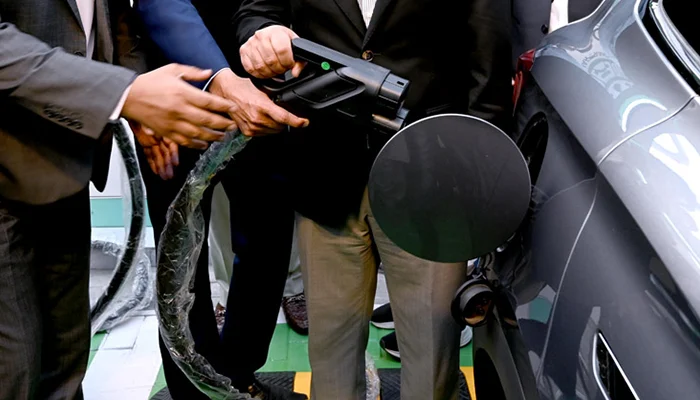
KARACHI: The Oil Companies Advisory Council (OCAC) has expressed concerns over mandatory electric vehicle (EV) charging requirements at petrol stations, suggesting that the link between K-Form issuance and the provincial mandate of 10% EV charger availability be withdrawn, The News reported.
The council also urged a review of regulations that make the installation of EV chargers a prerequisite for approval of new retail outlet layouts.
KARACHI: The Oil Companies Advisory Council (OCAC) has highlighted the commercial and operational challenges faced by oil marketing companies (OMCs) under the government’s New Energy Vehicles (NEV) policy, while reaffirming support for the long-term vision of cleaner energy, environmental sustainability, and the transition to electric vehicles (EVs).
The council noted that OMCs were not consulted during the policy formulation stage, despite being responsible for implementing EV charging infrastructure at retail outlets. In a letter to Minister for Petroleum Ali Pervez Malik, OCAC pointed out that the NEV policy, led by the Ministry of Climate Change, envisions charging facilities at multiple locations, including petrol stations.
While a special electricity tariff of Rs38.9 per unit has been approved for EV chargers, clarity on customs duties and other fiscal incentives for NEVs is still pending and expected to be finalized in FY2026.
OCAC flagged a mismatch between policy targets and market realities: the goal of achieving 10% NEV charging availability at retail outlets by 2030 is ambitious, as only 2,700–3,000 EVs were on the roads nationwide as of November 2025, compared with a projected 125,000 vehicles.
The council highlighted the high capital costs of Level-3 charging stations, estimated at Rs15–20 million per unit, excluding transformers and cabling, due to grid and backup power requirements. Currently, about 15 charging stations have been established nationwide, but most are operating at a loss because of low utilization.
Implementation challenges also include delays in NOC issuance by deputy commissioners, the mandatory linkage of K-Form issuance with Level-3 chargers, and directives in some jurisdictions to withhold approvals for new fuel station layouts unless EV chargers are included.
OCAC emphasized that, globally, EV charging is mostly done at residential areas, commercial complexes, hospitals, parks, and malls, where vehicles remain parked longer, whereas petrol stations are designed for quick turnover, limiting the commercial viability of high-capacity chargers at this stage of EV adoption.
The council called for a phased, demand-driven, and commercially sustainable framework developed in consultation with stakeholders including the Ministry of Climate Change, Ministry of Energy (Petroleum Division), OGRA, the National Energy Efficiency and Conservation Authority, and OMCs.
OCAC concluded that once a viable EV population and an enabling fiscal framework are in place, OMCs will expand charging infrastructure based on sound commercial principles, similar to their approach with alternative fuels like compressed natural gas (CNG).
About the Author