

The company highlights a strategic push to compete more aggressively in the rapidly expanding real-time AI market.
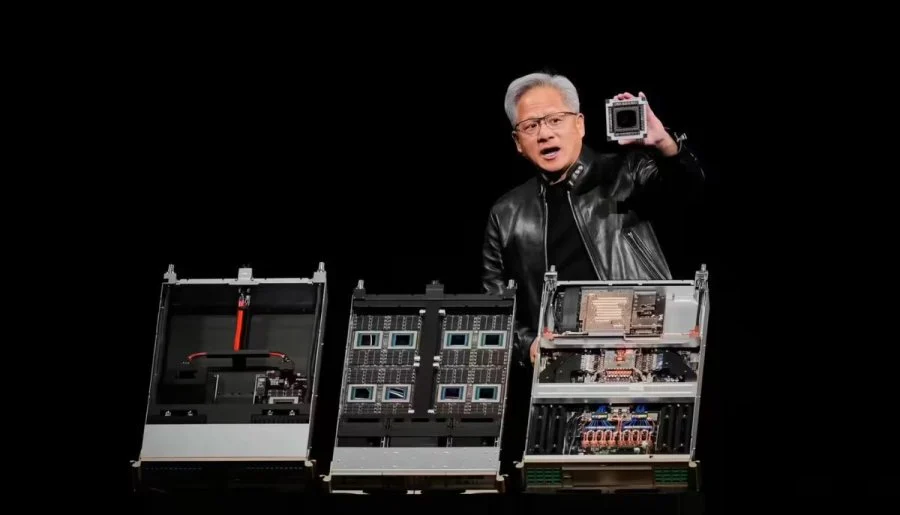
Nvidia has projected a revenue opportunity of at least $1 trillion through 2027, doubling its previous estimate of $500 billion through 2026. The company became the first to reach a $5 trillion valuation in October 2025. While shares initially jumped on the forecast, they closed with a modest 1.2% gain as investors weigh long-term growth against substantial internal reinvestments. This updated guidance highlights Nvidia’s strategy to compete more aggressively in the rapidly growing real-time AI market.
CEO Jensen Huang unveiled a new central processor and an AI system built on technology from Groq—a chip startup from which Nvidia licensed technology for $17 billion in December. The move aims to counter rivals like Google and other custom processor makers challenging Nvidia’s lead in real-time AI applications.
The announcements were accompanied by news of major partnerships and strategic collaborations, positioning Nvidia to solidify its dominance in AI hardware and software solutions.
Huang unveiled a new AI system leveraging technology from Groq, a startup Nvidia licensed for $17 billion in December 2025. The company also introduced a new central processor and shared updates on its roadmap for the upcoming Blackwell and Rubin chip architectures.
Nvidia continues to make significant investments in the broader AI ecosystem, including participation in OpenAI’s $110 billion funding round. Despite becoming the first company to reach a $5 trillion valuation last October, some investors have raised concerns about whether Nvidia’s strategy of reinvesting heavily into AI will yield the expected returns.
EMarketer analyst Jacob Bourne noted: “Huang mapping out a $1 trillion opportunity through 2027 underscores the durable demand for Nvidia’s AI infrastructure despite investor concerns. It signals Nvidia is maintaining its leadership in the AI chip market as the industry moves from early experimentation to large-scale deployment.”
Reports indicate that, despite the US ban, China’s DeepSeek has successfully trained AI models using Nvidia’s top-tier chips. Analysts say the $1 trillion forecast highlights Nvidia’s successful transition from the experimental phase of AI into full-scale industrial deployment.
About the Author