

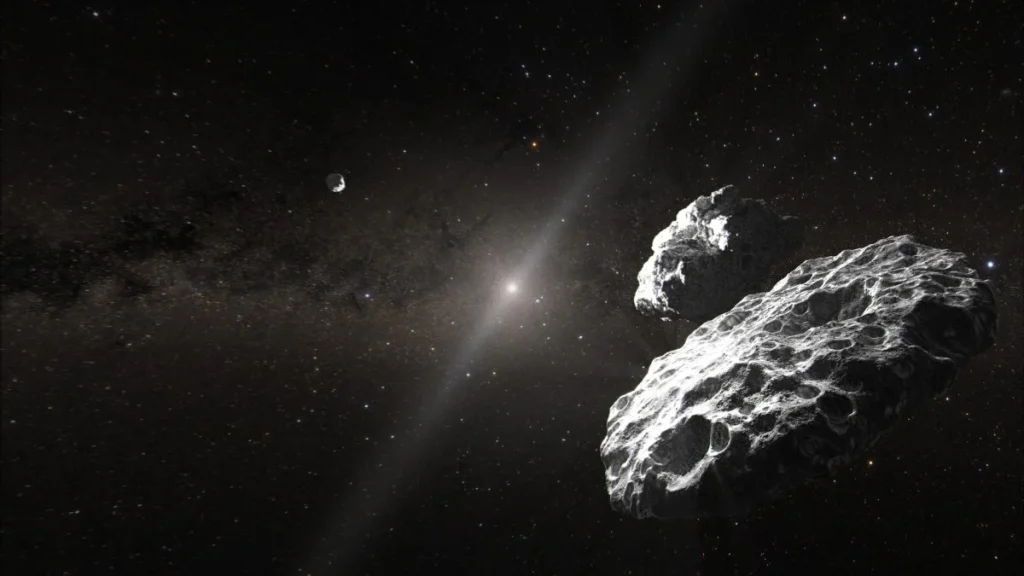
A newly discovered trio in the Kuiper Belt—potentially just the second system of its kind—may offer compelling evidence that these distant bodies formed through gravitational collapse rather than violent collisions, similar to the process that creates stars.
The universe contains many gravitationally bound three-body systems, ranging from triple star systems to planets with two moons, such as Mars. Now, new research indicates that the Kuiper Belt—a distant zone filled with icy objects—may also host similar systems. Scientists have discovered a second possible triple system in this region, where an object once believed to be a binary could actually include a hidden third body. This third object is so close to its partner that it can only be detected through its effect on the system’s orbital motion.
If confirmed, this finding would suggest that many more concealed triple systems may exist in the Kuiper Belt. More importantly, it would lend support to the streaming instability hypothesis, which proposes that Kuiper Belt objects did not form through collisions but instead originated as multiple systems through gravitational collapse.
The Hubble Space Telescope has revealed that a Kuiper Belt duo may actually be a trio. For centuries, predicting the motion of three gravitationally bound objects has challenged mathematicians—a problem recently popularized by the novel and TV series 3 Body Problem. Now, researchers have found what appears to be a stable trio of icy bodies in the Kuiper Belt, a distant region of the solar system. The discovery was made using data from NASA’s Hubble Space Telescope and the W. M. Keck Observatory.
A Rare Trio in the Kuiper Belt?
If confirmed, the 148780 Altjira system would be only the second known three-body system in this region, suggesting that many more may exist. This discovery could support theories about the early history of our solar system and the formation of Kuiper Belt objects (KBOs).
“The universe is filled with a variety of three-body systems, including nearby examples like the Alpha Centauri star system, and we’re beginning to see that the Kuiper Belt may be no exception,” said lead study author Maia Nelsen, a physics and astronomy graduate from Brigham Young University in Provo, Utah.
Kuiper Belt Objects: Remnants of the Early Solar System
First discovered in 1992, KBOs are ancient, icy relics from the early solar system that lie beyond the orbit of Neptune. More than 3,000 have been identified so far, though scientists believe hundreds of thousands more—each over 10 miles wide—may exist. The largest known KBO is the dwarf planet Pluto.
The Hubble discovery provides strong support for a theory suggesting that some KBOs did not form through collisions in the crowded Kuiper Belt. Instead, they may have formed directly as a trio through the gravitational collapse of material in the disk surrounding the young Sun about 4.5 billion years ago. While it is well established that stars can form through gravitational collapse—often in pairs or triples—whether smaller cosmic bodies in regions like the Kuiper Belt form in the same way is still under investigation.
Altjira: A Hidden Trio in the Outer Solar System
The Altjira system lies in the far reaches of the solar system, about 3.7 billion miles away—roughly 44 times the distance between Earth and the Sun. Images captured by the Hubble Space Telescope show two Kuiper Belt objects separated by about 4,700 miles (7,600 kilometers). However, scientists studying their unusual co-orbital motion suggest that the inner object may actually be two separate bodies. These two bodies are so close together that they cannot be resolved individually at such a vast distance.
“With objects this small and distant, the gap between the two inner components of the system is less than a single pixel on the Hubble Space Telescope, so non-imaging techniques are needed to determine that it’s actually a triple,” Nelsen explained.
This process requires patience and long-term observation. Scientists have collected 17 years of data from Hubble and the W. M. Keck Observatory, tracking the orbit of Altjira’s outer object over time.
“Gradually, we noticed changes in the orientation of the outer object’s orbit, suggesting that the inner body was either highly elongated or actually two separate objects,” said co-author Darin Ragozzine of Brigham Young University.
“When we modeled the Hubble data using different scenarios, the triple system configuration provided the best fit,” Nelsen added. “Other possibilities include a contact binary—where two bodies are so close they touch—or an unusually flat, pancake-like structure.”
A Growing Population of Three-Body Systems
Currently, about 40 binary objects have been identified in the Kuiper Belt. With two of these systems now likely to be triples, researchers suggest that this may not be a rare exception but part of a broader population of three-body systems formed under similar conditions. However, confirming this requires long-term data and repeated observations.
So far, the only Kuiper Belt objects studied in close detail are Pluto and the smaller object Arrokoth, which were explored by NASA’s New Horizons mission in 2015 and 2019. The mission revealed that Arrokoth is a contact binary—meaning two bodies that gradually moved together and now touch or have merged, often forming a peanut-like shape. Ragozzine describes Altjira as a “cousin” of Arrokoth, part of the same family of Kuiper Belt objects, though it is estimated to be about 10 times larger, measuring around 124 miles (200 kilometers) across.
An Eclipsing Event Offers New Clues
Although there are no planned missions to Altjira comparable to New Horizons, Nelsen noted that an upcoming eclipsing event will provide a valuable opportunity to learn more about this intriguing system.
Altjira has entered an eclipsing phase, during which the outer body passes in front of the central one. This phase will continue for the next ten years, offering scientists an exceptional opportunity to study the system in greater detail,” Nelsen said. The James Webb Space Telescope is also contributing to the research, with plans to examine whether the components share similar properties during its upcoming Cycle 3 observations.
The Hubble study was published in The Planetary Science Journal.
Reference: “Beyond Point Masses. IV. Trans-Neptunian Object Altjira Is Likely a Hierarchical Triple Discovered through Non-Keplerian Motion” by Maia A. Nelsen, Darin Ragozzine, Benjamin C. N. Proudfoot, William G. Giforos, and Will Grundy, March 4, 2025, The Planetary Science Journal.
DOI: 10.3847/PSJ/ad864d
The Hubble Space Telescope has transformed our understanding of the universe for more than 30 years. Launched in 1990 as a joint mission between NASA and the European Space Agency, it has delivered some of the most detailed images of deep space ever captured. Managed by NASA’s Goddard Space Flight Center, with support from Lockheed Martin Space, its scientific operations are conducted by the Space Telescope Science Institute in Baltimore, operated by the Association of Universities for Research in Astronomy (AURA). From measuring the universe’s expansion to discovering exoplanets and distant galaxies, Hubble continues to be one of the most influential observatories in astronomy.
Stay updated on major discoveries by following scientific news platforms like SciTechDaily on Google and Google News.
About the Author