
Pakistan emerged from an idea — the realization of a shared, collective dream.
History occasionally pauses at defining moments and asks a nation a powerful question: Do you dare to imagine a future different from your present? For the Muslims of South Asia, that moment came on 23 March 1940, when thousands gathered at Minto Park in Lahore under the banner of the All-India Muslim League and the leadership of Muhammad Ali Jinnah.
What emerged from that historic gathering was far more than a political resolution — it was a declaration of civilisational confidence. It marked the moment when a scattered and often marginalized community voiced a powerful aspiration: the right to live with dignity, security, and self-determination.
At the time, the idea seemed nearly impossible. Even many sympathetic observers dismissed it as political fantasy. Critics mocked Jinnah for demanding a separate homeland for Muslims of the subcontinent, calling his vision unrealistic — even claiming it was beyond reach.
History often proves that what seems impossible in one era can become inevitable in the next when guided by clear purpose and strong leadership.
The Lahore Resolution 1940 changed the course of millions of lives. In just seven years, the vision of a separate homeland evolved into reality. This demand did not arise suddenly; it was built upon decades of intellectual and philosophical groundwork. One of its strongest foundations came from Allama Muhammad Iqbal, who envisioned a political system where Muslims could shape their lives according to their values, culture, and historical identity.
Iqbal saw Muslims of the subcontinent as more than just a religious group — he viewed them as a distinct civilisation with a shared history and rich intellectual traditions. In his famous Allahabad Address 1930, he proposed that Muslim-majority regions be unified into a political entity where Muslims could freely develop their social and cultural institutions. His vision was not driven by opposition to others, but by the belief that large civilisational communities need structures that protect their identity and autonomy.
To turn this philosophical vision into a political reality required a leader skilled in constitutional strategy. At that time, Muhammad Ali Jinnah had stepped away from politics and was practicing law in London. Recognizing his potential, Iqbal encouraged Jinnah through persistent communication to return and lead the Muslim cause.
When Jinnah returned, he brought with him discipline, legal expertise, and unwavering determination. Under his leadership, the All-India Muslim League grew from a limited political body into a powerful mass movement representing millions of Muslims.
The demand for Pakistan was rooted in the belief that Muslims were a distinct nation with their own identity, culture, traditions, and worldview. Yet, it also carried a deeper concern: the fear of political marginalization in a system dominated by another majority. Many Muslims in British India worried that in a democratic framework, their interests might not be adequately protected, raising concerns about fairness, security, and representation.
The demand for Pakistan reflected a core principle: when a community feels insecure within a majoritarian political system, it seeks the right to determine its own future. At the same time, this vision carried an important moral responsibility. If Muslims sought a separate homeland due to fears of discrimination in a united India, then Pakistan itself had to guarantee that no minority within its borders would face the same injustice.
Thus, the dream of Pakistan was built on two guiding ideals:
- The self-realization of Muslim identity
- The protection and dignity of all minorities
Muhammad Ali Jinnah clearly expressed this vision in his historic address to the Constituent Assembly of Pakistan on 11 August 1947, emphasizing that all citizens were free to follow any religion or caste, and that the state would treat everyone equally without discrimination.
The Pakistan Movement therefore united the goal of Muslim self-determination with a strong commitment to pluralism and justice.
The rapid emergence of Pakistan as a sovereign state through democratic struggle stands as one of the most remarkable political transformations of the 20th century. From the Lahore Resolution 1940 to independence in 1947, just seven years passed. During this period, Muhammad Ali Jinnah faced significant challenges. He encountered firm opposition from the Indian National Congress, which resisted the idea of partition, as well as scepticism from British authorities who initially viewed the Muslim League’s demands as temporary or negotiable. Even within Muslim political circles, doubts persisted about whether such a transformation could truly be achieved.
Despite these obstacles, Jinnah’s leadership was marked by clarity, constitutional strategy, and unwavering resolve. He worked tirelessly to negotiate, build consensus among diverse Muslim groups, and present the demand for Pakistan with legal precision and political discipline.
One striking aspect of this struggle was Muhammad Ali Jinnah’s personal condition. In the final years of the independence movement, he was battling a serious illness, with his tuberculosis kept hidden from the public and known only to a very small circle, including his physician and close associates. This fact remained one of the most closely guarded secrets of 20th-century politics.
Years later, Lord Mountbatten reportedly acknowledged in Freedom at Midnight that had British leadership known about Jinnah’s critical condition, they might have postponed the transfer of power until after his passing—an action that could have changed the course of history. Pakistan’s emergence, therefore, unfolded within a remarkably fragile window in time.
The creation of Pakistan stands not only as a political achievement but also as a testament to Jinnah’s extraordinary leadership and unwavering resolve.
While many nations are shaped by geography, ethnicity, or long historical continuity, Pakistan was different. It was born from an idea — the realization of a shared dream. Millions came together with the belief that their future required a political system aligned with their cultural and civilisational identity.
This ideological foundation gives Pakistan a distinct identity among modern nation-states. Like all dreams, however, it requires continuous renewal. A dream does not end with the creation of a state—it evolves through each generation’s effort to realize its promises.
As we observe Pakistan Day, we must reflect honestly on our progress: how close are we to fulfilling that original vision? Over the decades, Pakistan has faced political instability, economic challenges, security concerns, and institutional weaknesses. Yet despite these difficulties, the dream that gave birth to the nation endures.
Our nation’s resilience reflects the strength of the ideals first expressed in the Lahore Resolution 1940. Today, Pakistan stands at another defining moment. The global landscape—geopolitical, geo-economic, and technological—is evolving rapidly. Countries that adapt and innovate move forward, while those clinging to outdated systems risk falling behind.
For Pakistan, the path ahead lies in reviving the very spirit that created the nation: belief in possibility, commitment to collective effort, and a shared vision of progress. This vision is reflected in initiatives like URAAN Pakistan, a development agenda aimed at accelerating economic growth and positioning Pakistan toward becoming a one-trillion-dollar economy by 2035 and a three-trillion-dollar economy by 2047, marking its centenary.
Our history offers powerful inspiration. If a nation could be envisioned and brought into existence in just seven years—from 1940 to 1947—then achieving ambitious economic goals in the coming decades is entirely possible. Today, we possess resources our founders did not: a sovereign state, abundant natural assets, established institutions, and above all, a young and talented population. With clear vision and disciplined execution, the journey toward transformation becomes not harder, but more achievable.
Yet true progress requires more than economic strategy—it demands self-belief. As a nation, we must rise above the pessimism that sometimes shapes our discourse. Excessive negativity and cynicism can weaken confidence, and no nation can advance without believing in its own potential.
The generation that created Pakistan did not give in to despair when the dream seemed out of reach. They trusted their collective strength and refused to accept limitations imposed by doubt. Today, we must revive that same spirit—reject division, discourage cynicism, and channel our energy into building a stronger, united, and forward-looking nation.
Pakistan’s true strength lies in its diversity—its regions, cultures, languages, and communities. When this diversity is aligned with a shared national purpose, it becomes a powerful driver of progress. The vision of URAAN Pakistan aims to harness the potential of the youth, strengthen economic foundations, and position Pakistan as a competitive, forward-looking, and innovative economy in the 21st century.
In many ways, this agenda reflects the modern continuation of the dream that inspired the Pakistan Movement. Muhammad Ali Jinnah captured the path to success in three timeless words: Unity, Faith, and Discipline.
These principles remain just as relevant today as they were during the struggle for independence. Unity turns individual abilities into collective strength. When a nation stands together around a common purpose, cooperation amplifies the impact of every citizen’s efforts. Faith builds confidence in our ability to overcome challenges. It reflects the spirit of Khudi—the belief that individuals and nations can shape their own destiny through self-awareness and determination. Discipline ensures that our ambitions are translated into real achievements. Without it, even the most powerful vision cannot be realized.
For Pakistan to achieve its development goals, these principles must guide our actions and shape our national character.
As we look ahead, it is essential to understand that development strategies cannot simply be borrowed from other contexts. For decades, countries like Pakistan have tried to replicate economic and political models shaped in the West during the 20th century. While these frameworks have offered valuable insights, they are not fully suited to the complexities of local conditions or the challenges of the 21st century.
In fact, many Western political and economic models are now being reassessed within their own societies. The world is entering a new era defined by rapid technological change, shifting demographics, environmental pressures, and evolving geopolitical dynamics.
Pakistan must develop its own model of development and governance—one rooted in its national ethos, social realities, and economic conditions. This model should balance innovation with inclusivity, economic growth with social justice, and modern advancement with cultural authenticity. It should also ensure that democratic governance acts as a catalyst for progress, rather than a source of disruption and instability.
Freedom of expression and association are essential pillars of democracy, but they must be practiced with responsibility and respect for the rule of law, so they do not lead to disorder, misinformation, or harmful polarisation. According to the World Economic Forum, misinformation and societal division are among the top global risks today.
In this context, Pakistan must promote a culture of constructive dialogue and responsible citizenship—one where democratic freedoms strengthen national unity and policy consistency, allowing the country to focus its energy on development, stability, and long-term prosperity instead of constant unrest.
We must channel the energy of our youth, empower women, promote education and entrepreneurship, and ensure that development reaches every region and community. Achieving this requires continuity in policies, political stability, and a collective commitment to reforms that strengthen our institutions and economy.
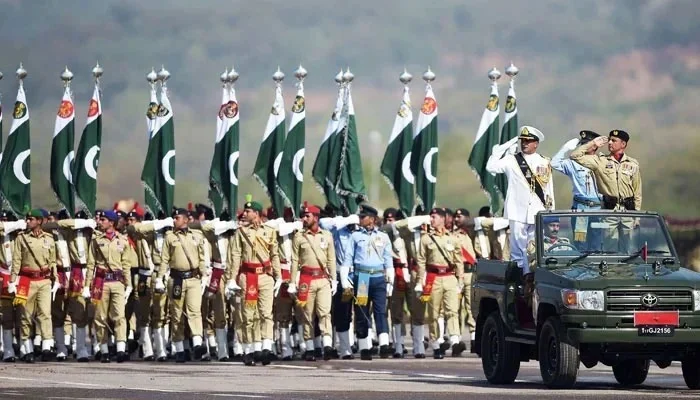
Pakistan Day is more than a remembrance of a historic resolution—it is a reflection of what a nation can accomplish when it unites around a shared vision. In 1940, the idea of Pakistan seemed out of reach, yet millions believed in it with such conviction that they turned it into reality. Today, we must summon that same courage, determination, and imagination.
The future of Pakistan will not be shaped by external forces alone. It will depend on the decisions we make as a nation—our unity, our confidence in our abilities, and our discipline in pursuing progress. By learning from our history and embracing the spirit that drove the Pakistan Movement, we can look forward to a new era of growth and renewal.
The dream that began in Lahore in 1940 still endures. It lives in the hopes of our youth, the resilience of our people, and our shared determination to build a stronger future.
Pakistan—a nation that upholds the ideals of justice, opportunity, and dignity for all.
On this Pakistan Day, let us reaffirm our commitment to turning that dream into a future that honours the vision of Allama Muhammad Iqbal and the leadership of Muhammad Ali Jinnah. After all, nations—like individuals—become what they believe they can be.
About the Author