
Large-eddy simulations offer a new way to create and analyze vortices with a central eye and surrounding eyewall within a confined space.
The internal dynamics and physics of tropical cyclones remain a major question in meteorology, and developing a reliable experimental model for such storms is still a challenge. While numerical models can reproduce large-scale vortices, it is still unclear what physical conditions are needed to form a vortex with a distinct eye and eyewall in a confined space.
Researchers led by Kannan et al. have created a simulation model to identify the hydrodynamic conditions under which vortices can form and evolve into cyclone-like structures in a controlled environment. Using large-eddy simulations of rotating convection in a shallow cylindrical setup, their approach mimics the effects of solar heating and Earth’s rotation. By adjusting thermal forcing and rotation rates, they discovered the conditions that allow cyclone-like formations to emerge.
According to lead author Veeraraghavan Kannan, this study builds a conceptual link between simplified rotating convection models and real-world geophysical vortices. He noted that the robustness of the mechanism was unexpected.
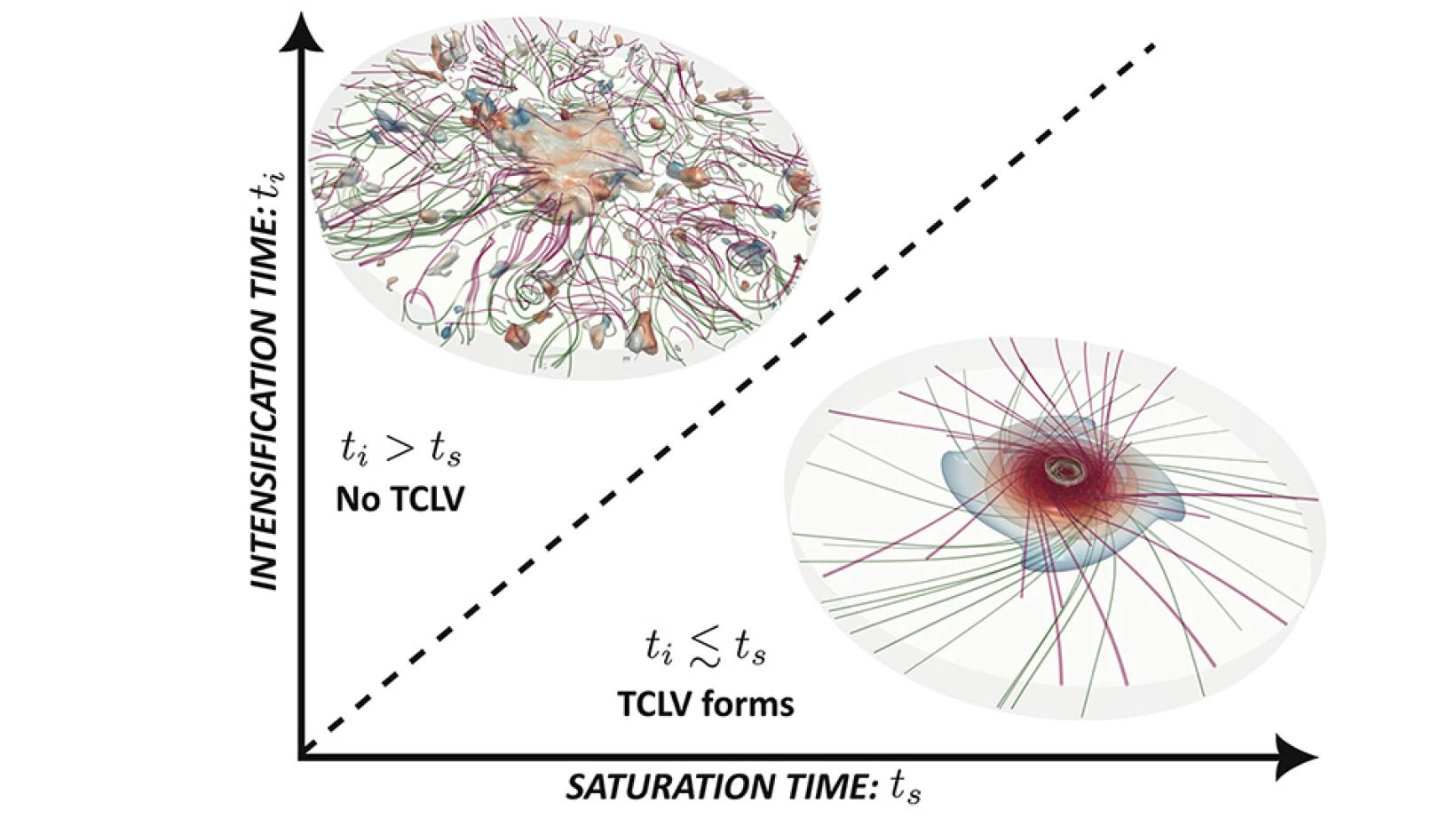
The team identified two key timescales in cyclone formation: one associated with intensification through angular momentum organization and eyewall development, and another related to the fluid’s rotational spin-up.
Remarkably, even without including moisture or latent heat, the model still produced realistic eye and eyewall structures. This indicates that basic hydrodynamic processes alone can organize turbulence into a cyclone-like vortex.
They also found that cyclone-like vortices form only when intensification occurs before the system reaches saturation. Based on this, they derived a simple criterion linking thermal forces and rotation to predict cyclone behavior in both laboratory experiments and simulations.
Moving forward, the researchers plan to extend their model to include moist convection and study how latent heat influences the balance between intensification, saturation, and vortex structure.
About the Author