
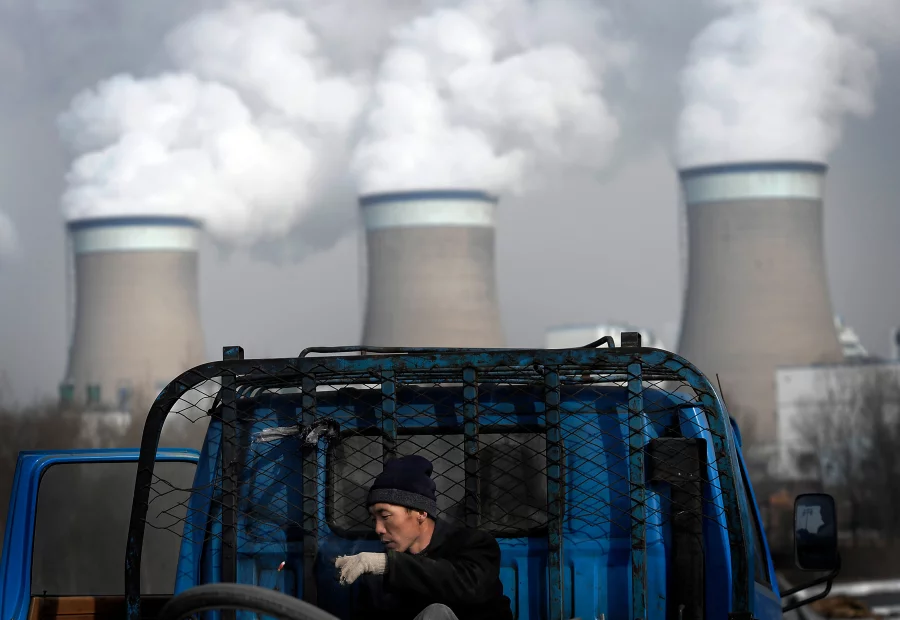
BANGKOK — Asian countries are increasingly turning to coal as the Iran war disrupts global oil and gas supplies.
The region is highly dependent on imported fuel, much of which passes through the Strait of Hormuz — a key chokepoint for around one-fifth of the world’s oil and natural gas trade.
Liquefied natural gas (LNG) is natural gas that has been cooled into liquid form for easier storage and transport. It has been promoted as a transitional fuel in the shift away from oil and coal toward cleaner energy sources. The United States has been working to expand LNG exports to Asia. While LNG burns cleaner than coal, it still releases greenhouse gases, particularly methane, that contribute to climate change.
The conflict has led several countries to turn back to coal to make up for shortfalls in liquefied natural gas (LNG). India is increasing coal use to meet rising summer electricity demand, while South Korea has lifted limits on coal-based power generation. Indonesia is focusing on using its domestic coal reserves, and countries such as Thailand, the Philippines, and Vietnam are expanding coal-fired electricity production.
However, greater reliance on coal could worsen air pollution in major cities, slow the shift toward renewable energy, and increase greenhouse gas emissions across the region.
Experts say coal is only a short-term solution, while renewable energy remains the long-term path forward. Continued dependence on coal leaves Asia vulnerable to future energy shocks, warned Julia Skorupska of the global coalition Powering Past Coal Alliance. She described the situation as “a real warning.”
Rising demand is pushing Asia back toward coal, which remains central to many countries’ emergency energy strategies. Its widespread availability across the region makes it the go-to backup when renewable or gas supplies fall short, according to Sandeep Pai.
China, the world’s largest coal consumer and producer, has expanded its coal power capacity to record levels since 2021 to strengthen energy security. Despite its growing clean energy sector, national policy still supports continued coal use as part of its energy mix.
India, the world’s second-largest consumer and producer of coal, is preparing for a severe summer and plans to depend more heavily on coal to meet peak electricity demand of around 270 gigawatts—almost double the power capacity of Spain. The country currently has coal reserves sufficient for roughly three months, with part of the stock reserved for small businesses.
Two Indian liquefied petroleum gas (LPG) shipments, totaling more than 92,700 tons, recently passed through the Strait of Hormuz. According to Sandeep Pai, such imports are likely to be used in industries like fertilizer production rather than for power generation.
Coal advocates, including Michelle Manook, argue that the shortfall would be even greater without coal and say its future use should be strategic. “The lesson has to be diversity,” she said.
Meanwhile, Pauline Heinrichs, who studies climate and energy, pointed to China’s increased reliance on coal to offset reduced hydropower output caused by droughts—an approach that has contributed to higher emissions linked to climate change.
“You learn to respond to shocks generated by certain insecurities by reproducing the insecurity,” she said.
Indonesia Prioritises Domestic Coal Use
Indonesia, the world’s largest coal exporter, is prioritising domestic consumption over exports, adding to the challenges faced by import-dependent countries. Experts say this shift could tighten regional supply and drive global prices higher, according to Putra Adhiguna of the Energy Shift Institute.
Coal prices are set on the global market, leaving importing countries vulnerable to price swings and supply disruptions. However, increased coal availability does not necessarily ensure affordable or reliable electricity, noted Russell Marsh of E3G.
Vietnam is already experiencing this volatility. After boosting imports due to weather-related shortages, it now faces uncertainty over supplies from Indonesia and is considering alternative imports from the United States and Laos, according to energy tracker Argus Media.
The benchmark price for coal in Asia, known as Newcastle coal from Australia, has risen by 13% since the start of the conflict.
Rising prices are expected to further strain Southeast Asia—the world’s third-largest coal-consuming region—where countries such as Vietnam, the Philippines, and Thailand are increasing their reliance on coal-fired power.
Relying on Coal Now Could Backfire
Increasing coal use in the short term could slow, and potentially undermine, long-term efforts to phase out coal-fired power.
Indonesia was already facing challenges in meeting its targets to retire coal plants early, with financing delays occurring even before the Iran war.
Coal power in Indonesia became 48% more expensive in 2024 compared to 2020, driven by aging plants and rising costs, according to the Institute for Energy Economics and Financial Analysis. At the same time, subsidies for the national utility increased by 24% to $11 billion, accounting for around 5% of the national budget.
The government in Jakarta has been promoting the use of liquefied natural gas (LNG) to support the transition away from coal. However, renewed reliance on coal “sends a signal” that shifting to gas “is not as easy as it sounds,” said Putra Adhiguna.
South Korea has committed to retiring most coal-fired power plants by 2040 and cutting emissions in half by 2035. Despite this, it continues to allow increased coal use when air pollution levels are low and LNG supplies are tight.
In 2023, South Korea needed to rapidly expand renewable energy—adding about 8 gigawatts of wind power annually—to meet its net-zero targets, according to Agora Energiewende. However, progress has been slow, with renewables making up just 10% of electricity in 2024, compared to a global average of 32%, according to Institute for Energy Economics and Financial Analysis.
Over the past 11 years, South Korea has committed $127 billion to fossil fuels—about 13 times more than its investment in renewables. Around 60% of its export financing has gone to LNG, while $120.1 billion was spent on fuel imports in 2024 alone, according to Joojin Kim.
South Korea still intends to phase out coal, but recent policy shifts may extend beyond the current crisis, according to Joojin Kim. “The concern is not just the decision itself—it’s the precedent it sets,” he said.
For countries with limited reliance on coal, such as Thailand, the impact on electricity prices is expected to be minimal. Jitsai Santaputra noted that coal makes up a relatively small share of the country’s energy capacity, with domestic coal accounting for less than 10% of Thailand’s energy mix.
Coal contributes to air pollution
Burning coal releases fine particulate matter that can penetrate deep into the lungs and enter the bloodstream, increasing the risk of heart disease, stroke, lung cancer, and chronic respiratory illnesses, according to the World Health Organization.
Air pollution is a widespread issue across Asia, particularly during periods when farmers burn crop residue.
In India, all 1.4 billion people are exposed to particle pollution levels that exceed safe limits set by the World Health Organization, according to a report by the Energy Policy Institute of Chicago. The government has temporarily relaxed air-quality regulations, allowing restaurants to use coal to help address a gas shortage.
Vietnam is also facing severe pollution, with PM2.5 levels far above WHO guidelines. The country is encouraging the use of electric bikes and has set targets to reduce coal consumption.
In Hanoi, shop owner Lan Nguyen said she understands the need for coal to maintain electricity supply, but remains concerned about its impact on her asthmatic son’s health. “I worry for my son’s lungs every day,” she said.
About the Author