

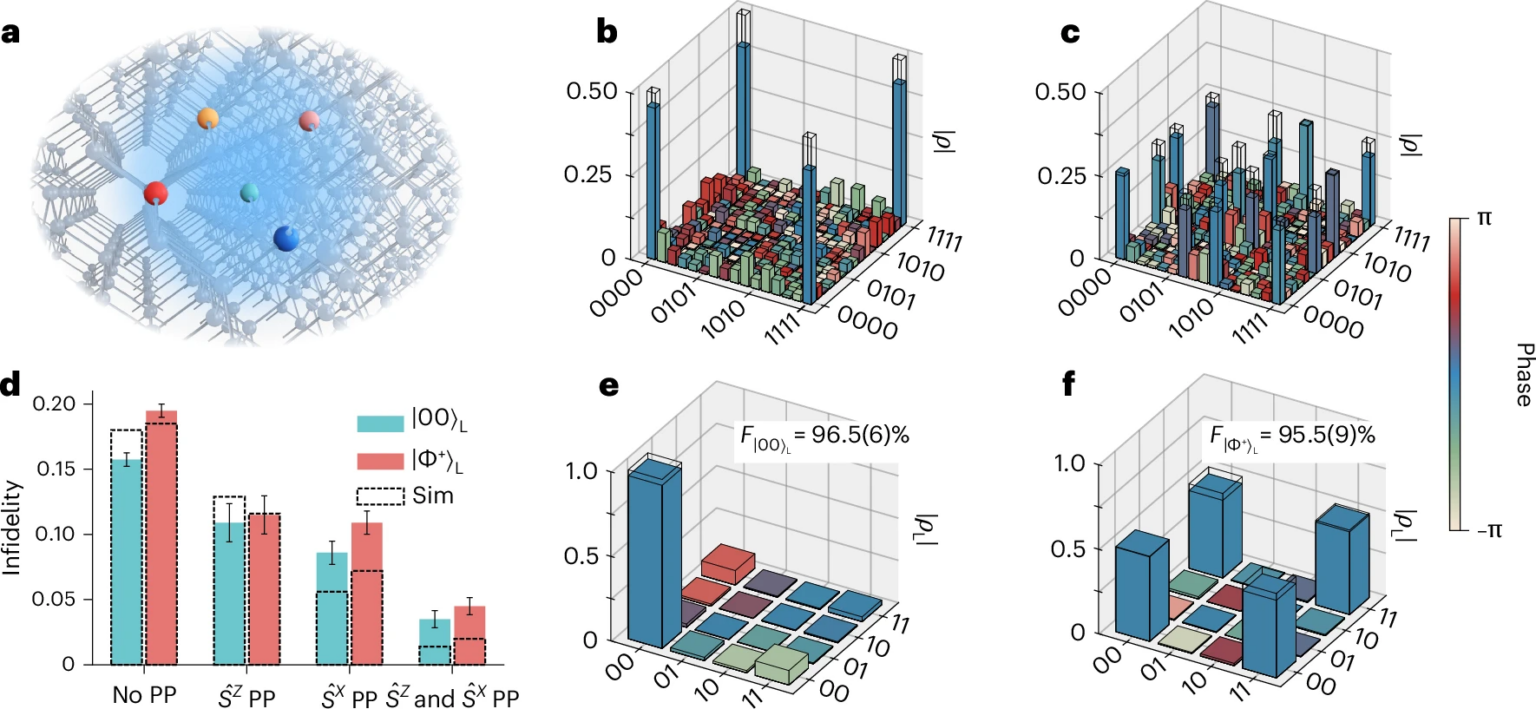
Researchers at the Shenzhen International Quantum Academy have demonstrated a silicon-based quantum processor capable of performing a universal set of logical gate operations. The processor uses a cluster of five phosphorus donor nuclear spins embedded in an isotopically purified silicon-28 lattice, precisely patterned with scanning tunneling microscopy (STM) lithography. To mitigate environmental noise, the system employs the [[4, 2, 2]] quantum error-detecting code, encoding two logical qubits across four physical qubits. This marks the first demonstration of universal logical operations on a silicon spin platform, notable for its compatibility with conventional semiconductor manufacturing.
The experimental setup characterized a universal logical gate set, including single-qubit Clifford gates, a simultaneous Hadamard gate, and a two-qubit CNOT gate. The non-Clifford T gate was implemented via the gate-by-measurement technique, using an ancillary nuclear spin to introduce the required phase rotation. Results showed average physical gate fidelities above 95%, with logical coherence times of roughly 208 microseconds. The processor exhibited a strong noise bias, with phase-flip (Z) errors dominating bit-flip (X) errors—a property that could reduce hardware overhead for large-scale fault-tolerant quantum architectures.
To demonstrate practical applications, the processor ran a Variational Quantum Eigensolver (VQE) algorithm to calculate the ground-state energy of a water molecule (H₂O). Using error mitigation techniques—parity checks, Clifford fitting, and symmetry verification—the team achieved an average energy deviation of 22.7 mHa from theoretical values. This confirms the potential of logical silicon qubits for running meaningful quantum algorithms.
Future development will focus on reducing cross-talk between donor clusters and scaling the architecture to larger arrays to support more advanced error-correction schemes.
For full technical details, refer to the Nature Nanotechnology study, the South China Morning Post report, and the summary at Interesting Engineering.
About the Author