

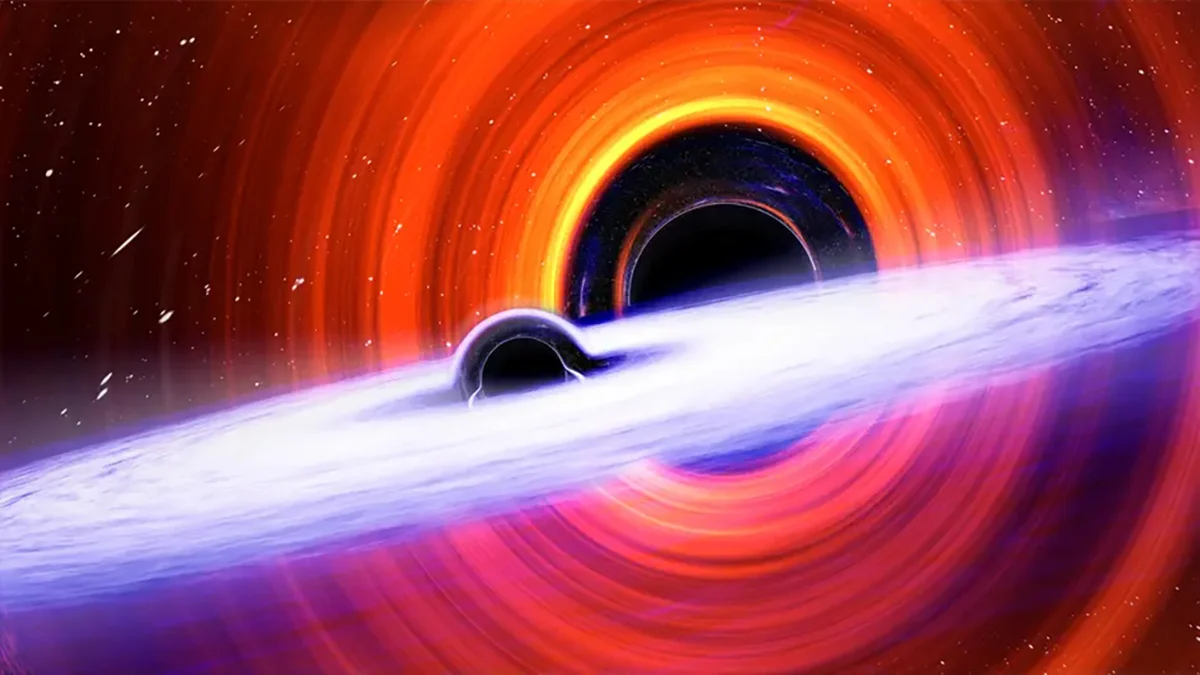
Primordial black holes (PBHs) are a unique class of black holes, believed to have formed from dense regions of subatomic matter within the first second after the Big Bang. A new study now reports what could be the first direct observation of such an object.
While confirming this may take years, the prospect is electrifying.
Unlike typical black holes, which arise from the collapse of massive stars, PBHs are thought to have existed in the earliest moments of the Universe without the need for a star. Until now, they remained purely theoretical, though mounting evidence is beginning to suggest they might be real.
Astrophysicists Alberto Magaraggia and Nico Cappelluti of the University of Miami may have identified another candidate PBH using the Laser Interferometer Gravitational-Wave Observatory (LIGO), which operates across sites in Washington and Louisiana.
Primordial black holes (PBHs) are an extraordinary type of black hole, believed to have formed from dense pockets of subatomic matter within the first second after the Big Bang. A recent study suggests that scientists may have finally observed one directly.
Proving this discovery could take years, but the possibility is truly exciting.
Unlike typical black holes, which form when massive stars collapse, PBHs are thought to have emerged in the Universe’s earliest moments, requiring no stars at all. Long considered purely theoretical, recent evidence is beginning to support their existence.
Astrophysicists Alberto Magaraggia and Nico Cappelluti from the University of Miami may have detected another possible PBH using the Laser Interferometer Gravitational-Wave Observatory (LIGO), which operates at two sites in Washington and Louisiana.
The gravitational waves detected by LIGO are ripples in spacetime, often caused by the collision of two black holes. A signal observed by LIGO and analyzed by the researchers suggested a collision where one of the objects had a mass smaller than that of the Sun—raising the possibility that it could be a primordial black hole.
“The most common black holes form from a supernova, the explosive death of a massive star,” explains Cappelluti. “Their masses can range from a few times that of the Sun to billions of solar masses.”
Primordial black holes, in contrast, are expected to have far lower masses.
“We believe our study will help confirm that PBHs truly exist,” Cappelluti adds.
Further analysis of the signal, labeled S251112cm, is required for confirmation, but the researchers say that the most likely explanation is the presence of a primordial black hole with a mass smaller than the Sun.
Magaraggia and Cappelluti also calculated the expected frequency of primordial black holes in the Universe and how often LIGO might detect them. Their predictions aligned with LIGO’s data since it began observing gravitational waves in 2015.
“We tried to estimate how many primordial black holes could exist in the Universe and how many LIGO might be able to detect,” says Magaraggia.
“Our findings are promising. We expect subsolar black holes like the one LIGO may have observed to be rare, which matches the infrequent detection of such events so far.”
Like regular black holes, PBHs do not allow light to escape, making them extremely hard to spot. They are also thought to be smaller than typical black holes, in some cases possibly as tiny as asteroids.
When you factor in the challenge of looking back across billions of years, detecting these objects is like searching for needles in a vast cosmic haystack. Yet, if primordial black holes can be identified and mapped, they could offer crucial insights into another cosmic mystery: dark matter.
Like primordial black holes, dark matter remains hypothetical, but astrophysicists estimate it could account for about 85 percent of the Universe’s mass and play a key role in holding galaxies and other structures together. While dark matter cannot be seen directly, its presence is inferred from the effects it has on the motion of stars, galaxies, and the fabric of spacetime itself.
Some experts believe that PBHs could make up a significant portion of dark matter. They may have existed in enormous numbers from the very beginning, starting as minuscule objects and gradually expanding to populate the vast reaches of space.
Confirming their existence will require detecting more PBHs, but this is becoming increasingly possible as observatories like LIGO are upgraded and new instruments, such as the European Space Agency’s Interferometer Space Antenna (LISA), a gravitational wave detector set to launch in 2035, come online.
About the Author