
Islamabad and Beijing also urge warring parties with Iran to permit the early passage of civilian and commercial ships through the Strait of Hormuz
Pakistan and China Urge US, Israel, and Iran to End Hostilities and Begin Peace Talks
Pakistan and China have jointly called on the United States, Israel, and Iran to halt hostilities and commence “peace talks as soon as possible” to resolve the ongoing conflict in the Middle East.
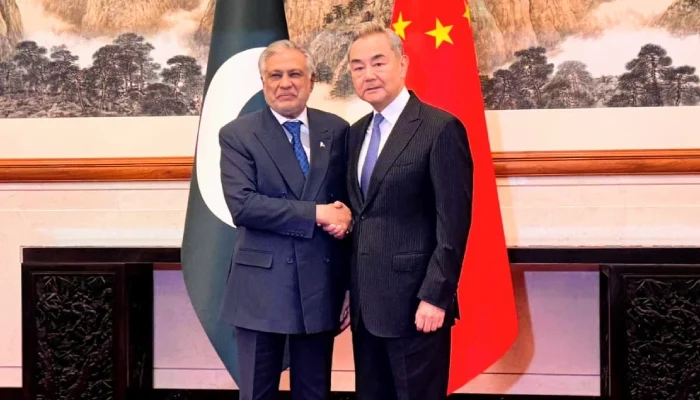
The appeal followed a meeting in Beijing on Tuesday between Deputy Prime Minister and Foreign Minister Ishaq Dar and China’s Foreign Minister Wang Yi, according to a Foreign Office statement.
The month-long conflict, which began on February 28, has significantly impacted the wider Middle East and triggered serious economic disruptions. Iran’s effective blockade of oil and gas shipments through the Strait of Hormuz since the outbreak of attacks has further intensified global economic challenges.
During the discussions, both sides stressed the “immediate cessation of hostilities” and the importance of preventing the conflict from spreading. They also called for unhindered humanitarian access to all war-affected areas.
This high-level bilateral engagement underscores Islamabad’s intensified efforts to mediate an end to the US-Israel-Iran conflict.
Pakistan and China Call for Immediate Dialogue, Regional Peace, and Protection of Civilians
Pakistan recently hosted key regional ministers from Saudi Arabia, Turkiye, and Egypt to facilitate dialogue and relay messages between Washington and Tehran. Following this quadrilateral meeting in Islamabad, Deputy Prime Minister and Foreign Minister Ishaq Dar met Chinese Foreign Minister Wang Yi in Beijing to review bilateral ties and discuss regional and mutual issues.
In the joint statement after their meeting, Pakistan and China called for the immediate initiation of dialogue, emphasizing the protection of Iran’s and Gulf states’ sovereignty, territorial integrity, independence, and security.
“Dialogue and diplomacy are the only viable means to resolve conflicts. China and Pakistan support all relevant parties in starting talks, with a commitment to peaceful resolution and refraining from the use or threat of force,” the statement said.
The two nations also urged parties to halt attacks on civilians and non-military targets and to fully adhere to international humanitarian law. They called for the protection of critical infrastructure, including energy, desalination, power facilities, and peaceful nuclear sites such as nuclear power plants.
Recognizing the Strait of Hormuz as a vital global shipping route for goods and energy, Pakistan and China stressed the need to protect ships and crew members and ensure the early and safe passage of civilian and commercial vessels. They urged the swift restoration of normal shipping traffic in the waterway.
Further, both countries highlighted the importance of practicing true multilateralism to strengthen the United Nations’ primacy. They called on the parties involved in the Iran conflict to support the creation of a comprehensive peace framework and work toward lasting peace.
Meanwhile, US President Donald Trump reportedly told aides he is willing to end military operations against Iran even if the Strait of Hormuz remains largely closed, leaving reopening operations for later, according to the Wall Street Journal.
Earlier, Deputy Prime Minister Dar noted that the quadrilateral meeting of Pakistan, Saudi Arabia, Turkiye, and Egypt had called for an immediate and permanent end to the ongoing Middle East conflict. In a televised address, he said Pakistan hosted the talks to address rising regional tensions caused by the Iran war.
Pakistan and China Strengthen Strategic Partnership
During the Beijing meeting, Dar and Yi also reviewed bilateral relations, regional developments in West Asia, and a broad range of mutual interests. Both sides reaffirmed their commitment to strengthening the “all-weather strategic cooperative partnership” as they mark the 75th anniversary of diplomatic relations this year.
Discussions included advancing high-quality development, deepening economic and strategic cooperation—especially under the China-Pakistan Economic Corridor (CPEC) 2.0—and enhancing high-level exchanges and collaboration across multiple sectors.
They reaffirmed close coordination at multilateral forums and agreed to maintain regular, close communication. The Foreign Office said Dar’s visit reflects the “enduring warmth, mutual trust, and iron-clad friendship” that define Pakistan-China relations.
About the Author