
“We can see the Moon through the docking hatch right now—it’s an absolutely stunning view,” said astronaut Christina Koch.

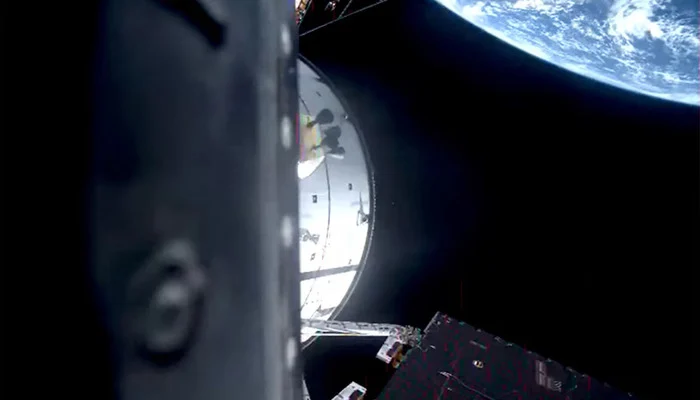
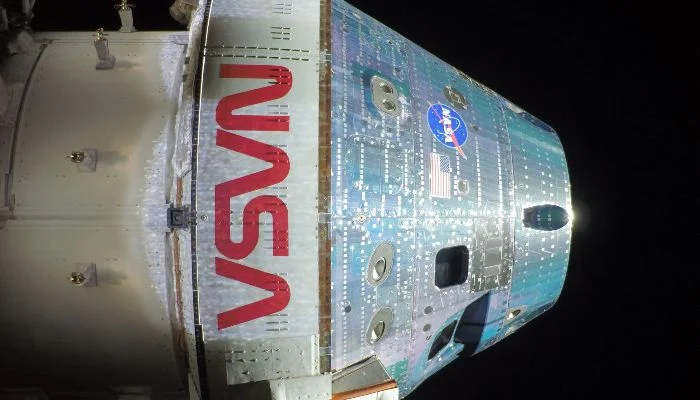
HOUSTON: The Artemis 2 astronauts reached the halfway mark between Earth and the Moon on Saturday as they continue toward their scheduled lunar flyby, with NASA sharing the first images of Earth captured from inside the Orion spacecraft.
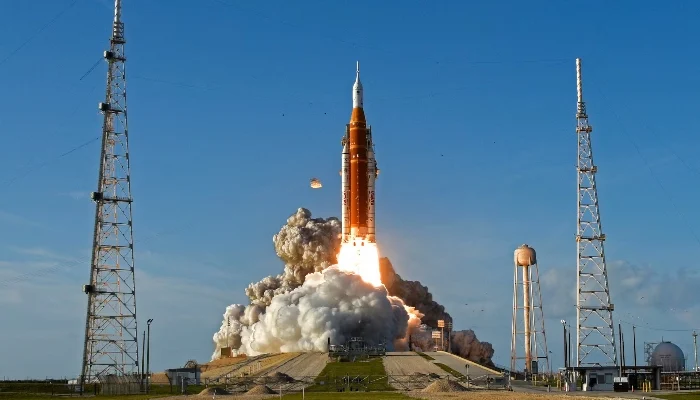
Astronaut Christina Koch said the crew shared a collective “expression of joy” upon reaching the milestone, which occurred roughly two days, five hours, and 24 minutes after liftoff from Kennedy Space Center in Florida.
“We can see the Moon through the docking hatch right now—it’s a beautiful sight,” Koch said around 11 pm (0400 GMT) Friday, according to NASA’s official live broadcast.
By early Saturday, NASA’s online dashboard showed the Orion spacecraft carrying the Artemis 2 crew was over 229,000 kilometres (142,000 miles) from Earth.
The space agency also released images from Orion, including a full view of Earth showcasing its deep blue oceans and swirling clouds.
Following a series of high-stakes maneuvers—including a dramatic launch and an engine burn that placed them on their historic path around the Moon—the four astronauts were able to catch their breath, while continuing essential equipment checks and tests.
“There’s been an incredible sense of awe for me—it’s just so extraordinary,” said Canadian astronaut Jeremy Hansen during a press Q&A late Thursday.
“I really love it up here,” Hansen, on his first spaceflight, added. “The views are absolutely stunning.”
“Floating around in zero gravity is really fun,” he continued. “It makes me feel like a little kid again.”
Hansen is part of the Artemis 2 crew alongside Americans Christina Koch, Victor Glover, and Reid Wiseman.
The team is scheduled to loop around the Moon early next week, a milestone not achieved in more than 50 years.
NASA official Lakiesha Hawkins praised the images taken by commander Wiseman, calling them “amazing” during a briefing Friday.
“We continue to learn more about our spacecraft as we operate it in deep space with a crew for the first time,” Hawkins said. “It’s important to note that we’re learning a little more each day.”
‘Great spirits’
Friday’s tasks include a CPR demonstration, medical kit checks, and preparations for scientific observations the astronauts will perform when closest to the Moon on day six of their mission, the US space agency said.
NASA officials reported Friday that all systems were functioning smoothly, and the astronauts were in “great spirits” and had spoken with their families.
The next major milestone of the roughly 10-day mission is expected overnight Sunday into Monday, when the crew will enter the “lunar sphere of influence”—the point at which the Moon’s gravity exerts a stronger pull on the spacecraft than Earth’s.
If everything proceeds as planned, the Orion spacecraft could carry the astronauts farther from Earth than any humans in history during their lunar flyby.
“There is nothing normal about this,” mission commander Reid Wiseman said late Thursday. “Sending four humans 250,000 miles away is a Herculean effort, and we are only now starting to grasp the magnitude of it.”
The Artemis 2 mission is part of NASA’s broader plan to return humans to the Moon repeatedly, ultimately aiming to establish a permanent lunar base to support further exploration.
About the Author