

NASA’s gumdrop-shaped Orion capsule, named Integrity, safely parachuted into the ocean off the Southern California coast.
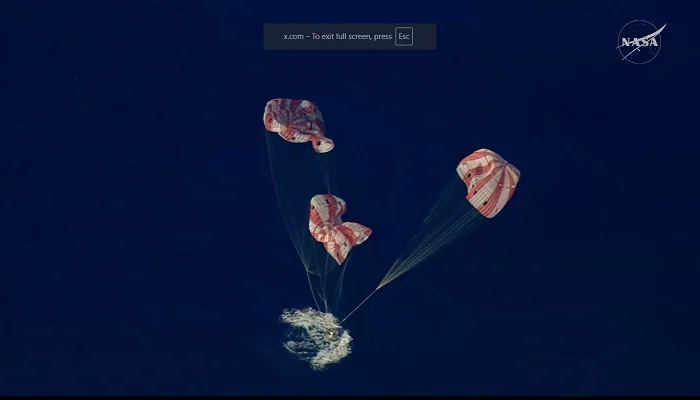
The Artemis II capsule, carrying a four-member crew, reentered Earth’s atmosphere and safely splashed down in the Pacific Ocean on Friday after nearly 10 days in space, completing the first human journey to the moon’s vicinity in more than 50 years.
NASA’s gumdrop-shaped Orion capsule, named Integrity, descended by parachute into the sea off the Southern California coast shortly after 5 p.m. PT, bringing to an end a mission that sent astronauts farther into space than ever before.
The Artemis II mission traveled a total of 694,392 miles (1,117,515 km), completing two orbits of Earth and a dramatic lunar flyby about 252,000 miles away. It marked the first crewed test flight in NASA’s Artemis program, which aims to begin landing astronauts on the moon as early as 2028.
The splashdown, which occurred roughly two hours before sunset, was broadcast live on a NASA webcast.
Recovery teams were on standby to secure the floating capsule and retrieve the crew—U.S. astronauts Reid Wiseman, Victor Glover, and Christina Koch, along with Canadian astronaut Jeremy Hansen.
The crew’s return marked a crucial final test for the Lockheed Martin-built Orion spacecraft, demonstrating its ability to endure the intense forces of re-entry from a lunar trajectory.
The capsule underwent a tense 13-minute descent through Earth’s atmosphere, where friction pushed exterior temperatures to around 5,000°F (2,760°C). At peak stress, a blazing layer of ionized gas—plasma—formed around the spacecraft, temporarily cutting off radio contact with the crew.
Communication was restored as the capsule emerged from the blackout phase, and two sets of parachutes deployed from its nose, slowing the descent to about 15 mph (25 km/h) before a smooth splashdown.
NASA and U.S. Navy recovery teams were expected to take about an hour to secure the capsule, assist the astronauts out, and transport them to a nearby recovery ship for initial medical checks.
A stepping stone to Mars
The four astronauts launched from Cape Canaveral, Florida, on April 1 aboard NASA’s powerful Space Launch System rocket, entering Earth orbit before heading toward a rare journey around the far side of the moon.
They became the first humans to travel near the moon since the Apollo missions of the 1960s and 1970s. Victor Glover, Christina Koch, and Jeremy Hansen also made history as the first Black astronaut, the first woman, and the first non-U.S. citizen, respectively, to take part in a lunar mission.
At its farthest point, the Artemis II mission reached 252,756 miles from Earth, surpassing the previous record of about 248,000 miles set by Apollo 13 in 1970.
Following the uncrewed Artemis I mission in 2022, this journey served as a key rehearsal for a planned lunar landing later this decade—the first since Apollo 17 in 1972.
The broader goal of the Artemis program is to establish a sustainable human presence on the moon, paving the way for future missions to Mars.
Like the Apollo era during the Cold War, Artemis II unfolded amid global political tensions and social challenges. However, unlike the earlier U.S.-Soviet space race, today’s competition is largely focused on China.
For many around the world, the mission highlighted the power of science and technology at a time when trust in major tech institutions has waned. Public opinion polls indicated strong support for the mission’s objectives.
The return also tested Orion’s heat shield, which had experienced greater-than-expected wear during the 2022 test flight. In response, NASA engineers adjusted the re-entry trajectory for Artemis II to reduce heat buildup and improve safety.
Meanwhile, the successful launch marked a major achievement for the Space Launch System, offering long-awaited validation for its primary contractors, Boeing and Northrop Grumman, that the rocket is ready to carry humans safely into space.
About the Author