
The Orion capsule is set to swing around the Moon, marking a key step that will send the crew farther from Earth than any humans have ever travelled before.
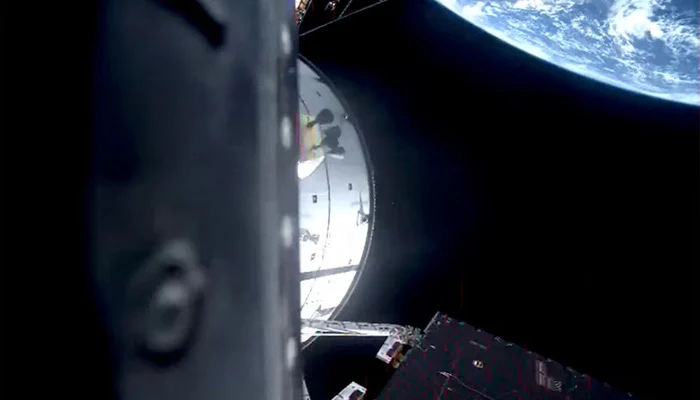
The Artemis astronauts entered the final stage of their approach to a lunar flyby on Monday, a key milestone in which the Moon’s gravity now exerts a stronger pull on the spacecraft than Earth’s.
The Orion capsule is now set to swing around the Moon, taking the crew farther from Earth than any humans have ever travelled before.
The astronauts entered what NASA calls the Moon’s “sphere of influence” at around 0442 GMT on Monday, marking the beginning of their first lunar flyby since 1972.
At the time of entry into the Moon’s gravitational pull, the crew was approximately 39,000 miles (63,000 km) from the Moon and about 232,000 miles from Earth, according to NASA’s livestream.
The mission also brings several historic firsts. Among the three Americans and one Canadian on board, Victor Glover will become the first person of colour to fly around the Moon, while Christina Koch will be the first woman to do so. Canadian astronaut Jeremy Hansen will become the first non-American to achieve the feat. All four astronauts, including mission commander Reid Wiseman, will spend much of the flyby observing and documenting the lunar surface.
The crew has already begun viewing parts of the Moon never seen by the human eye. NASA released an image captured by the Artemis astronauts showing the distant Moon with the Orientale basin visible. The agency noted, “This mission marks the first time the entire basin has been seen with human eyes.”
The vast crater, often compared to a “bullseye,” had previously only been photographed by orbiting spacecraft. Koch, speaking live to Canadian students from space, described the basin as a remarkable sight, noting it is sometimes called the Moon’s “Grand Canyon.” She added that no humans had ever seen it directly until this mission.
Near the end of the flyby, the astronauts are also expected to witness a solar eclipse, when the Sun passes behind the Moon and is visible only as a glowing corona.
In addition, the crew will test their Orion crew survival system spacesuits. The orange suits, designed for launch and re-entry safety, can also provide emergency support for up to six days of breathable air. This marks the first time the suits are being used in space, with astronauts evaluating how quickly they can be worn and pressurised.
Although the crew will not land on the Moon, they are expected to set a new record for the farthest distance humans have travelled from Earth during the flyby.
NASA officials said the astronauts will soon pass over the Moon’s far side and surpass the previous distance record, providing valuable data on the spacecraft’s performance. NASA administrator Jared Isaacman said the findings will be crucial for future missions, including Artemis 3 in 2027 and a planned lunar landing in 2028.
The crew has already completed manual piloting tests and reviewed their flight path, focusing on lunar features they will observe and photograph. Isaacman said the mission is especially important for evaluating the spacecraft’s life-support systems, noting that this is the first time astronauts have flown aboard the Orion capsule.
He added that the primary goal is to gather data essential for future deep-space missions.
About the Author