
Trump has accused Iran of a “total violation” of the ceasefire agreement, warning of serious consequences and renewed strikes on key infrastructure if Tehran does not comply with his terms.
He also reiterated threats of severe retaliation, including targeting critical facilities such as power plants and bridges, unless Iran agrees to a new deal.
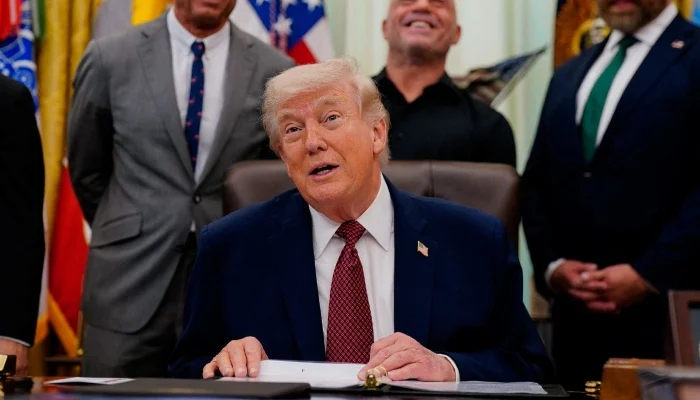
US President Donald Trump has confirmed that American negotiators will arrive in Islamabad on Monday for the second round of talks with Iran, while warning Tehran of serious consequences if it refuses a peace agreement with Washington.
In a post on his Truth Social account on Sunday, Trump wrote, “My representatives are going to Islamabad, Pakistan — they will be there tomorrow evening, for negotiations.”
He also accused Iran of a “total violation” of the ceasefire between the two countries, claiming it involved attacks on ships near the Strait of Hormuz. Trump renewed his warning, saying he could target Iran’s infrastructure, including bridges and power plants, if his terms were not accepted.
“We’re offering a very fair and reasonable DEAL, and I hope they take it because, if they don’t, the United States is going to knock out every single Power Plant and every single Bridge in Iran,” he said. “NO MORE MR. NICE GUY!”
Meanwhile, conflicting reports have emerged regarding the composition of the US delegation heading to the second round of talks with Tehran.
According to Axios, US President Donald Trump said his son-in-law Jared Kushner and Special Envoy to the Middle East Steve Witkoff were en route to Islamabad for the negotiations.
However, NBC News reported that Vice President JD Vance—who previously led Washington’s delegation in earlier talks—will also be part of the team. The outlet, citing the US ambassador to the United Nations, added that Vance is expected to lead the delegation.
In related developments, global oil prices declined while stock markets rallied on Friday after Iran announced it would reopen the Strait of Hormuz, which it had largely restricted to shipping since the conflict with Israel and the US began on February 28.
After President Trump stated that the US would continue a blockade on Iranian shipping, Tehran announced on Saturday that it would keep the Strait of Hormuz closed. At least two vessels also reported coming under fire while approaching the waterway that same day.
“Iran decided to fire bullets yesterday in the Strait of Hormuz — a total violation of our ceasefire agreement!” Trump wrote in a Sunday morning post, adding, “That wasn’t nice, was it?”
Security on high alert
Meanwhile, an advance US team has already arrived in Islamabad as Pakistan prepares to host the second round of negotiations between Washington and Tehran, according to sources. Additional advance delegations from other countries are also said to be reaching Pakistan ahead of the high-level talks.
Authorities in Islamabad and Rawalpindi have placed the federal capital on heightened security alert, sealing off the Red Zone to all traffic as precautionary measures.
The broader Middle East conflict began on February 28 following joint US-Israeli strikes, quickly escalating as Iran restricted access to the Strait of Hormuz and launched retaliatory attacks on Israel and US bases across the Gulf region.
Following a ceasefire facilitated by Prime Minister Shehbaz Sharif, both sides held initial talks in Islamabad over the weekend covering multiple disputes, though a final agreement has yet to be reached.
Pakistan has continued diplomatic efforts to ease tensions, including Chief of Army Staff and Chief of Defence Forces Field Marshal Asim Munir’s visit to Tehran, where he met senior Iranian political and military leadership.
Shortly after his visit, Iran reopened the Strait of Hormuz, citing the ceasefire agreement between Israel and Lebanon, but later closed it again, blaming Washington’s naval blockade of Iranian ports.
Despite ongoing differences, Iranian Parliament Speaker Mohammad Bagher Ghalibaf said discussions with the US have made “progress,” though significant gaps remain.
“We are still far from the final discussion,” he said in a televised address.
About the Author