

Astronauts aboard NASA’s Orion capsule made the transition roughly 39,000 miles from the Moon, entering a region where its gravitational pull is stronger than Earth’s.
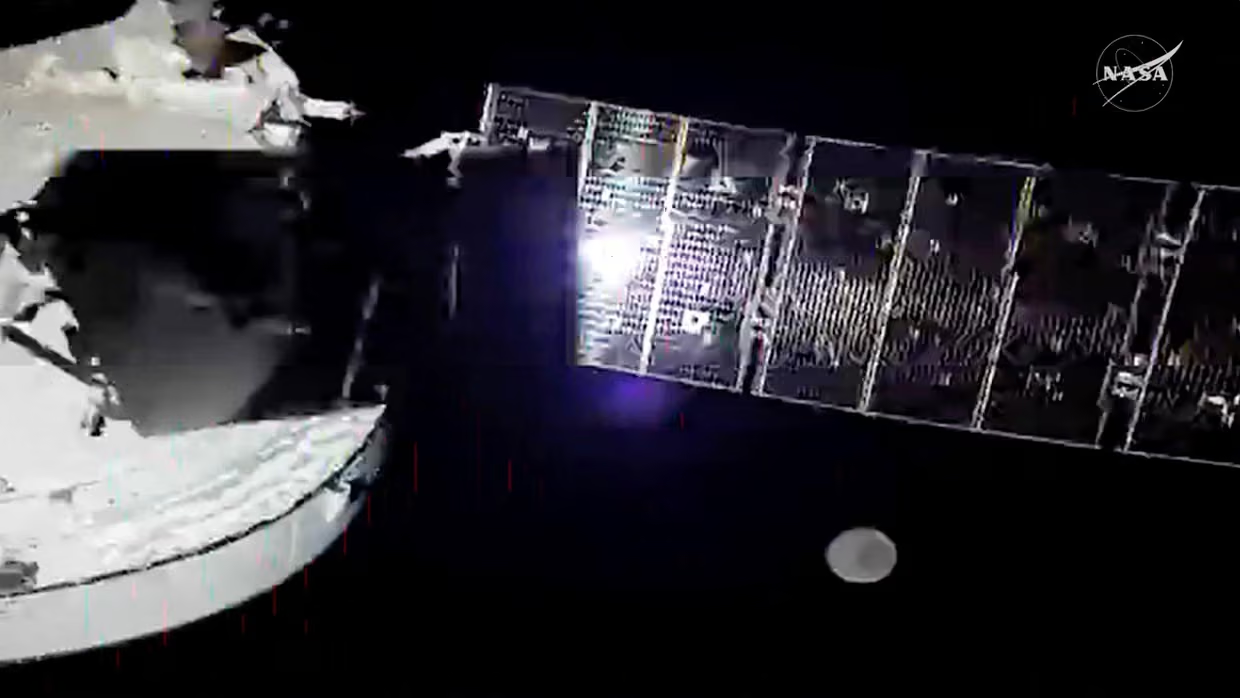
The four astronauts on NASA’s Artemis II mission have entered the Moon’s “sphere of influence,” where its gravity exerts a stronger pull on the spacecraft than Earth’s.
The transition occurred four days, six hours, and two minutes into the mission, at approximately 39,000 miles (62,800 km) from the Moon and 232,000 miles (373,400 km) from Earth. The next major milestone is the crew’s journey to the far side of the Moon later on Monday, venturing deeper into space than any humans have gone before.
“We’re all extremely excited for tomorrow,” said Lori Glaze, deputy associate administrator for NASA’s Exploration Systems Development Mission, on Sunday. “Our flight operations team and our science team are ready for the first lunar flyby in more than 50 years.”
The four astronauts on NASA’s Artemis II mission have entered the Moon’s “sphere of influence,” where its gravity exerts a stronger pull on the spacecraft than Earth’s.
The transition occurred four days, six hours, and two minutes into the mission, at approximately 39,000 miles (62,800 km) from the Moon and 232,000 miles (373,400 km) from Earth. The next major milestone is the crew’s journey to the far side of the Moon later on Monday, venturing deeper into space than any humans have gone before.
“We’re all extremely excited for tomorrow,” said Lori Glaze, deputy associate administrator for NASA’s Exploration Systems Development Mission, on Sunday. “Our flight operations team and our science team are ready for the first lunar flyby in more than 50 years.”
During the six-hour flyby, the crew will observe the Moon with their naked eyes and onboard cameras. The mission promises unprecedented views of the Moon’s far side, areas that were too dark or difficult to see for the 24 Apollo astronauts who came before them.
As Orion passes behind the Moon, the mission will enter a planned communications blackout of about 40 minutes, with the lunar surface temporarily blocking radio signals from the Deep Space Network.
“I think it’s important to remember that we don’t always know exactly what they’re going to see,” said Kelsey Young, lead scientist for the Artemis II mission, during a press conference on Sunday.
If all goes according to plan, as the Orion spacecraft swings around the Moon, the astronauts—Americans [“people”,”Christina Koch”,”NASA astronaut”], Wiseman”,”NASA astronaut”], and entity[“people”,”Victor Glover”,”NASA astronaut”], along with Canadian Jeremy Hansen—could set a record by traveling farther from Earth than any human in history.
The crew has already witnessed parts of the lunar surface never seen by human eyes. In the early hours of Sunday, NASA shared an image captured by Artemis II, showing the Moon with the Orientale Basin—sometimes called the Moon’s “Grand Canyon”—clearly visible.
“This mission marks the first time the entire basin has been seen with human eyes,” NASA said. The massive crater, which resembles a bullseye, had previously only been photographed by orbiting spacecraft.
On day five of the 10-day mission, Orion was nearly 215,000 miles (346,000 km) from Earth and 65,000 miles from the Moon, according to NASA’s online dashboard.
Former astronaut Charlie Duke, who walked on the Moon in 1972, gave the ceremonial wakeup call. “Below you on the Moon is a photo of my family. I pray it reminds you that we in America and all of the world are cheering you on. Thanks to you and the whole team on the ground for building on our Apollo legacy with Artemis,” said the 90-year-old.
NASA reported that the Artemis crew had completed a manual piloting demonstration and reviewed their lunar flyby plan, including the surface features they need to analyse and photograph during their orbit.
At the same time, “we’re focusing very much on the ecosystem, the life support system of the spacecraft,” said NASA chief Jared Isaacman in a televised CNN interview. “This is the first time astronauts have ever flown on this spacecraft before. That’s what we’re most interested in getting data from.”
On day five of the mission, NASA reported that the astronauts were testing their “survival” suits. These bright orange suits are worn during takeoff and re-entry, as well as in emergency situations such as cabin depressurisation. While the four astronauts will not land on the lunar surface, they are expected to set a record for the farthest distance from Earth during their orbit around the Moon.
“Over the next day, when they are on the far side of the Moon, they will surpass that record, and we’re going to learn an enormous amount about the spacecraft,” said Jared Isaacman.
The data gathered will be crucial for planning future missions, including Artemis III in 2027 and the lunar landing on Artemis IV in 2028.
An extraordinary act of foresight
In 1936, John Scott, son of the late Guardian owner and legendary editor CP Scott, took a remarkable step for a media heir: he gave up his financial stake in the newspaper for the greater good.
After inheriting the Guardian, Scott renounced all financial benefits—except his salary—and transferred ownership to the newly formed Scott Trust. The Trust’s mission was clear: to safeguard the Guardian’s financial and editorial independence indefinitely.
This structure ensures that the Guardian cannot be purchased—neither by private equity, conglomerates, nor billionaires seeking a political platform.
Here are three reasons to support the Guardian today:
- Its investigative journalism holds the powerful accountable in a world where the rich and influential often evade scrutiny.
- Its independence means there is no billionaire controlling the reporting; your support directly powers its journalism.
- Supporting it costs little and takes less time than reading this message.
The Guardian relies on readers around the world, including in Pakistan, to maintain its independence. Your support ensures that news is guided by journalists and editors—not shareholders or ultra-wealthy tech moguls.
About the Author