
A number of free websites now use AI to transform data into interactive world maps.
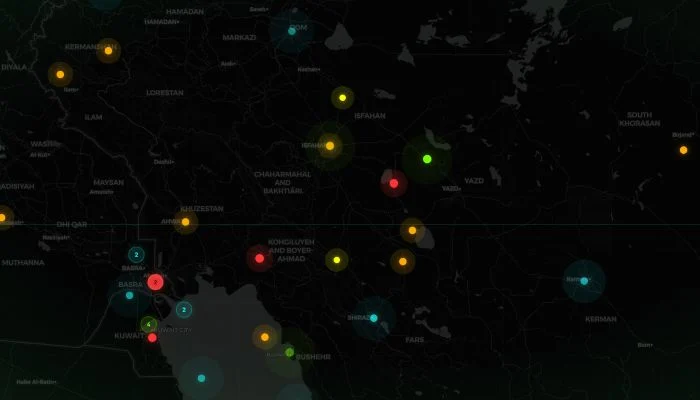
The AI dashboard displays frigates positioned near Cyprus and military aircraft heading toward the Gulf, while a breaking news alert marks unconfirmed reports of a drone strike in Dubai.
At that moment on Friday, more than 3,200 users were closely watching “Monitor the Situation,” a platform that tracks everything from the movements of world leaders to global internet outages.
Several free websites are using artificial intelligence to transform vast amounts of data into interactive global maps — tools that are rich in information but not always fully reliable.
Interest in these platforms has surged since conflict erupted in the Middle East, accompanied by memes gently poking fun at users who enjoy the feeling of operating a movie-style control centre.
“I think it’s human psychology — people feel like they have a kind of God’s view,” said Elie Habib, the creator of the AI dashboard “World Monitor.”
Habib, the CEO of Middle Eastern music streaming platform Anghami, told AFP that World Monitor has recorded 4.4 million visits since he launched it in January.
“I just want to understand what’s happening in the world,” said the 53-year-old Dubai-based entrepreneur, who originally imagined the tool as a “Bloomberg Terminal for geopolitics.”
Although the war has driven a sharp rise in interest, Habib said he has avoided placing advertisements on the site because he does not want to profit from the conflict.
World Monitor displays more than 450 data sources on a dense, customizable interface. It includes live webcams from key global locations and AI-selected headlines from established news outlets.
On the interactive map, users can track a wide range of real-time events — from protests and GPS jamming to earthquakes occurring around the world.
Habib said he is now trying to take the platform to the next level by “extracting the signals from the noise,” adding that without this step the overwhelming flow of information can simply become too much.
‘Not mere eye-candy’
Habib, a trained engineer based in Dubai, said he used AI to “vibe-code” the website over a single weekend — a task he believes would have taken at least a year if he had written the computer code manually.
The inner workings of “World Monitor” are open source, allowing other programmers to suggest improvements and modifications that Habib has since incorporated into the platform.
Websites such as “World Monitor” and “Monitor the Situation,” co-created by a staff member of US venture capital firm Andreessen Horowitz, feature numerous eye-catching functions. However, experts warn that users should not automatically treat all of their insights as fully reliable.
“They are not mere eye-candy… but they are not truth engines either,” said Wei Sun, principal analyst for AI at Counterpoint Research, in comments to AFP.
She explained that “the hallucination risk is real” when AI models attempt to interpret the significance of information or identify causal links between events.
Despite the possibility of inaccurate data, Sun noted that these AI dashboards “satisfy a very modern psychological need.”
“In a crisis, people want speed, synthesis and a sense of control when headlines are fragmented and overwhelming,” she said.
Some of these platforms also include chatrooms where users can interact with one another, according to Sun Sun Lim, a professor of communication and technology at Singapore Management University.
She said such features are “especially engaging during unfolding events.”
Lim also noted that growing public interest in global developments has been fuelled by the rise of prediction markets, where people place bets on outcomes ranging from national elections to whether Iran’s supreme leader might be removed from power. Live feeds from these betting markets are sometimes displayed on AI dashboards.
This raises the question of whether traditional news organisations such as AFP or Reuters should be concerned about audiences turning to these platforms for updates on global events.
“They should worry somewhat, but not existentially,” said Counterpoint’s Sun.
“In my view, the real disruption isn’t that AI dashboards will replace news wires, but that they could push them further upmarket — positioning them as the most trusted sources for verification and deeper explanation.”
About the Author