
Known as the “Forbidden Island,” Kharg Island is a small, ancient coral outcrop in the Persian Gulf that processes around 90 % of Iran’s crude oil exports, making it the linchpin of the country’s petroleum trade while also guarding centuries of human history beneath its guarded surface.
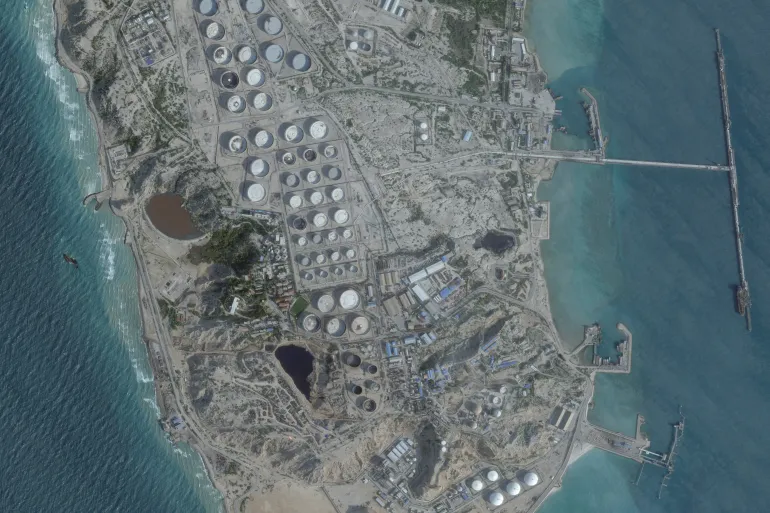
Beneath the scorching Gulf sun, the steady hum of millions of barrels of crude oil coursing through subsea pipelines resonates against the ancient coral rock.
It was on these isolated shores that the renowned Iranian writer Jalal Al-e-Ahmad once stood, famously dubbing the island the “orphan pearl of the Persian Gulf.”
Today, this 22-square-kilometre (8.5-square-mile) coral outcrop in Bushehr province is widely referred to by Iranians as the “Forbidden Island.”
Veiled in secrecy and heavily guarded by the Islamic Revolutionary Guard Corps (IRGC), access is strictly limited to those holding official security clearances.
Yet, beyond the steel fences and watchtowers, the island conceals a pristine landscape where millennia of human history quietly coexist with the pulsing hub of Iran’s modern energy empire.
The Petroleum Nerve Centre
Situated 55 km (34 miles) northwest of Bushehr port and just 15 nautical miles (28 km) from the Iranian mainland, Kharg Island serves as the undisputed economic backbone of Iran.
The island processes 90 percent of the nation’s total oil exports, handling nearly 950 million barrels annually.
Measuring only 8 km (5 miles) long and 4–5 km (2.5–3 miles) wide, its deep surrounding waters offer a strategic advantage, allowing colossal supertankers to dock safely. These vessels primarily transport crude to Asian markets, with China emerging as the largest importer.
According to the Iranian Ministry of Petroleum, Kharg Island’s facilities serve as the vital nerve centre of the country’s oil sector. The terminal receives crude from three major offshore fields – Aboozar, Forouzan, and Dorood – which is then transported through a complex network of subsea pipelines to onshore processing facilities before being stored or exported to global markets.
Despite years of international sanctions that periodically hindered its operations, Iran has aggressively expanded and upgraded Kharg Island’s oil infrastructure, increasing storage capacity and renovating key export facilities to maintain its role as the country’s critical crude export hub.
In May 2025, S&P Global Commodity Insights reported that Tehran expanded Kharg Island’s storage capacity by two million barrels, rehabilitating tanks 25 and 27, each capable of holding one million barrels.
Historically, the island’s continuously upgraded terminals have reached a loading capacity of up to seven million barrels per day, though current national exports average around 1.6 million barrels daily, alongside supplying crude for domestic consumption.
Empires and Exiles
Long before the discovery of oil, Kharg Island’s strategic maritime location made it a coveted prize for conquerors. While some have mistakenly linked the name “Kharg” to the ancient inland city of Charax Spasinou—founded by Alexander the Great near modern-day Basra at the confluence of the Tigris and Karkheh rivers—archaeological evidence confirms the two are unrelated.
Over the centuries, the island’s name has evolved in local dialects and on European maps, appearing variously as Kharg, Khark, Kharaj, and Kharej. Its natural freshwater springs and prime location established it as a vital maritime crossroads, facilitating the export of agricultural goods and minerals.
During the European colonial era, the Portuguese first seized control of Kharg along with other Gulf islands. By the mid-18th century, Dutch ambitions had begun to take root, marking another chapter in the island’s long history of contested power.
In 1752, the Dutch Baron Kniphausen secured an agreement with Mir Naser Al-Zaabi, the ruler of Bandar Rig, to establish a trading post. The following year, the Dutch East India Company constructed a heavily garrisoned fort to protect its commercial interests.
However, this colonial foothold was short-lived. After years of rising tensions, Mir Muhanna, governor of Bandar Rig, attacked the fortress and expelled the Dutch forces in January 1766, ending their presence on the island.
In the 20th century, Kharg Island’s story took a darker turn when Reza Shah Pahlavi, Shah of Iran from 1925 to 1941, converted it into a remote exile for political prisoners, leaving much of its potential untapped. It was only after 1958 that the island entered the modern petroleum era, beginning its transformation into the energy hub it is today.
Shedding its grim penal past, Kharg Island was chosen to become a major crude export hub, with its deep-water terminal officially commissioned and sending its first significant shipment in August 1960. As offshore oil fields were discovered throughout the 1960s, Kharg surpassed the Abadan port, attracting huge supertankers to its deep-water berths and cementing its role at the heart of Iran’s energy exports.
Echoes of a Diverse Past
Beneath Kharg Island’s modern industrial exterior lies a rich archaeological heritage. Evidence of human settlement stretches back to the end of the second millennium BC, encompassing the Elamite, Achaemenid, and Sassanid eras, and revealing a tapestry of civilizations that shaped the island long before oil defined its global significance.
Among Kharg Island’s most venerated sites is the Mir Mohammad Shrine, built in the late 7th century AH, featuring two conical domes crafted from rock and mud.
Nearby stands the Mir Aram Shrine, which houses a 12-metre (39 ft) stone inscribed with Islamic texts and flanked by two torches believed to date back to the Achaemenid period. Local tradition links this site to Mir Aram, a descendant of the Quranic and biblical prophet Noah.
The island is a living testament to religious and cultural plurality. Its ancient heritage cemetery showcases a mosaic of faiths, including:
- Zoroastrian burial sites
- Christian graves
- Sassanid-era tombs
Other historic landmarks scattered across Kharg include the remains of the 1747 Dutch Fort, the Dutch Garden, the Kharg Orchard, an old railway line, Islamic cemeteries, and a deeply significant Achaemenid inscription. This coral rock engraving, measuring 85 by 116 cm (33 by 46 inches), is celebrated as one of the oldest archaeological records explicitly mentioning the “Persian Gulf”.
Kharg Island bears the enduring scars of its geopolitical prominence, having withstood relentless bombardments during the Iran-Iraq War of the 1980s before being painstakingly rebuilt by Iranian authorities.
Today, as regional tensions continue to threaten the Persian Gulf’s strategic waterways, the island remains heavily militarised, restricting tourist access and inadvertently preserving its pristine ecological landscape.
Amid the hum of supertankers gliding through the deep Gulf waters, carrying the economic lifeblood of a heavily sanctioned nation, the ancient Zoroastrian and Christian graves stand as silent witnesses. They serve as a haunting reminder that while empires rise and energy wars rage, the “orphan pearl” of the Persian Gulf endures, forever tethered to the turbulent tides of history.
About the Author