
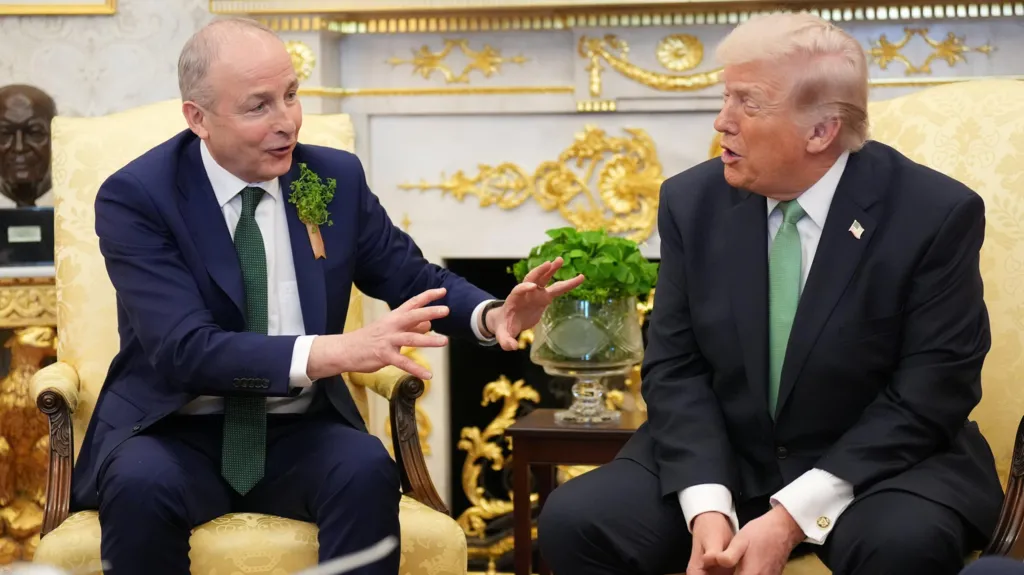
Every year, Ireland’s Taoiseach Micheál Martin travels to the United States to mark St. Patrick’s Day and meets the U.S. president at the White House.
This year, during his meeting with Donald Trump on Tuesday, the discussion quickly shifted to global issues, particularly the war involving Iran and broader tensions in the Middle East.
As a result, Martin had to respond carefully and stay composed, as the talks were dominated by sensitive geopolitical topics rather than the usual ceremonial focus.
The US president directed sharp criticism at the UK, pointing to what he described as its limited involvement and support in US–Israeli strikes on Iran.
He reiterated his remark that UK Prime Minister Sir Keir Starmer was “no Winston Churchill,” referencing Britain’s most renowned wartime leader.
Donald Trump also said he was “disappointed” in the prime minister, claiming he had not been supportive of the US in the Middle East and accusing him of making a “big mistake” regarding Iran.
Ireland’s Taoiseach Micheál Martin, who had hosted Starmer just days earlier at a UK–Ireland summit in Cork, stepped in to defend him.
He said Starmer had played a key role in improving Anglo-Irish relations, describing him as “a very earnest, sound person” and someone with whom people can work constructively.
Martin also addressed the comparison to Churchill, noting that while Churchill was an important wartime leader, his legacy is viewed differently in Ireland due to the country’s experience during the War of Independence.
What did Martin say in the Oval Office about immigration?
During the discussion, Irish Taoiseach Micheál Martin responded to comments by Donald Trump, who claimed that European countries, including the UK, had allowed “millions and millions” of people to enter who should not be there.
Martin said that Europe remains “a very good place to live” and argued that it is sometimes unfairly portrayed as being overrun. He added that Ireland does not support illegal immigration, noting that population growth in the country is being driven positively by economic opportunities that attract people to work legally.
At other moments, Martin chose not to respond directly, demonstrating careful judgment about when to engage and when to stay silent. He avoided direct confrontation while navigating pointed remarks from the president, including criticisms about European countries and Ireland’s economic competitiveness.
He also sidestepped questions from journalists about the conflict in the Middle East, declining to comment on whether the war was illegal and avoiding sensitive topics such as civilian casualties.
In another instance, Martin did not correct a mistake when Trump referred to Irish President Catherine Connolly as “he,” maintaining a diplomatic and non-confrontational approach throughout the meeting.
What was the reaction in Ireland and the UK?
After around 40 minutes of intense questioning with the unpredictable US president, Irish Taoiseach Micheál Martin managed to leave the meeting without any major controversy. His performance was seen as neither a clear victory nor a defeat, drawing mixed reactions across Ireland and the UK.
Ireland’s Justice Minister Jim O’Callaghan praised Martin’s handling of the situation, calling it an “excellent job in extremely challenging circumstances” and saying he had represented Ireland and Europe well.
Former UK cabinet minister Rory Stewart also commended Martin for speaking “fluently and diplomatically” while defending shared values and European allies.
Former Irish ambassador to the US Dan Mulhall said the Taoiseach successfully protected Ireland’s economic relationship with the US, describing the visit as a difficult but well-handled engagement.
Ben Judah, an adviser to UK politician David Lammy, highlighted Martin’s defence of UK Prime Minister Sir Keir Starmer as a sign of strengthening ties between Ireland and the UK.
However, not all reactions were positive. Social Democrat leader Holly Cairns called the meeting a “missed opportunity,” criticising Martin for being too quiet, and argued that inviting Donald Trump to Ireland would be inappropriate given concerns over international law.
Sinn Féin also criticised the Taoiseach, with spokesperson Donnchadh Ó Laoghaire saying he failed to raise key issues such as international law and conflicts in Gaza and Iran.
On the other hand, former Fianna Fáil adviser Derek Mooney praised Martin’s performance, saying his remarks symbolised European unity and were handled coherently.
Irish Labour leader Ivana Bacik, however, described the Taoiseach as being sidelined during the meeting, suggesting that Trump dominated the discussion.
About the Author