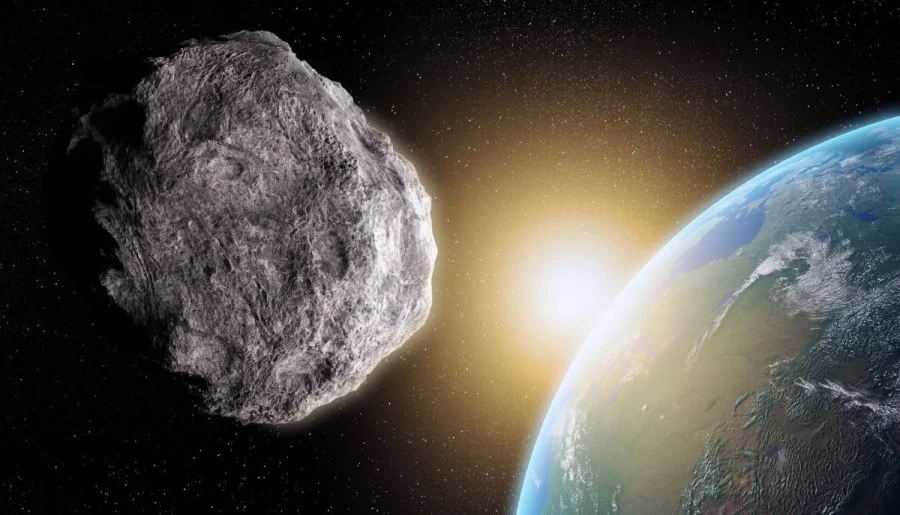

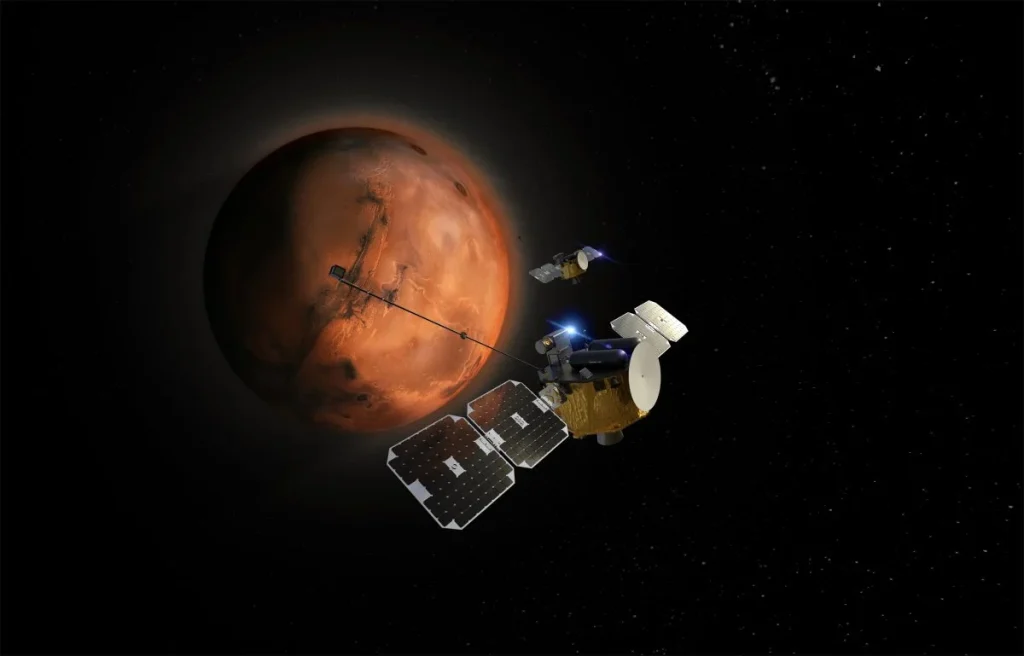
NASA’s twin ESCAPADE spacecraft are set to investigate how the Sun gradually stripped Mars of its atmosphere.
Mars was once a very different world. Scientists believe it had a thicker atmosphere, liquid water on its surface, and a much warmer climate. Today, it is cold, dry, and covered by only a thin layer of gas.
The primary driver of this transformation is the solar wind—a continuous flow of charged particles emitted by the Sun. Over billions of years, this stream steadily eroded much of Mars’ atmosphere. As the atmosphere thinned, temperatures dropped and surface water gradually vanished.
NASA’s ESCAPADE Mission Explores Mars’ Atmospheric Loss
To better understand this transformation, NASA launched the ESCAPADE (Escape and Plasma Acceleration and Dynamics Explorers) mission on November 13, 2025. Its scientific instruments became fully operational on February 25.
The mission will examine how Mars lost its atmosphere and how ongoing solar activity continues to influence the planet. It will also gather valuable data on space weather near Earth and throughout its journey to Mars.
Once it reaches Mars, the mission’s findings could help NASA prepare for future human exploration by improving understanding of the planet’s harsh environment.
“The pioneering ESCAPADE duo will not only study the Sun’s role in turning Mars into an uninhabitable world, but will also help shape space weather protocols for solar events affecting future human missions to the Red Planet,” said Joe Westlake.
He added that by joining NASA’s heliophysics fleet across the solar system, ESCAPADE will act like another “space weather station,” helping make both astronauts and technology safer and more effective in space.
Twin Spacecraft Offer a New Perspective on Mars
ESCAPADE is the first mission designed to operate two spacecraft together in orbit around Mars. This dual approach allows scientists to gain a clearer view of the planet’s magnetosphere and monitor how it changes over short periods of time.
Having two spacecraft will allow us to better understand cause and effect—how the solar wind interacts with Mars’ magnetic field,” said Michele Cash of NASA.
Previous missions studied Mars using a single spacecraft. In contrast, ESCAPADE provides simultaneous observations from two positions, helping scientists connect events occurring in different regions more effectively.
“The ESCAPADE mission is a game changer,” said Rob Lillis of the University of California, Berkeley. “It offers what you could call a stereo perspective—two viewpoints at the same time.”
When the spacecraft arrive at Mars, they will initially share the same orbit, passing over identical regions at slightly different times. This strategy helps scientists pinpoint when and where changes occur.
“When two spacecraft cross the same regions in quick succession, we can track variations on timescales as short as two minutes,” said Rob Lillis. “This will allow measurements we’ve never been able to make before.”
After about six months, the spacecraft will shift into separate orbits—one closer to Mars and the other farther away. During this phase, expected to last around five months, scientists will be able to observe incoming solar wind and the planet’s response at the same time.
“Earlier missions could either study the upstream solar wind or measure conditions near the planet,” Lillis explained. “ESCAPADE allows us to observe both cause and effect simultaneously.”
Why Mars Is More Dangerous for Humans
Future astronauts on Mars will face much higher exposure to solar radiation than people on Earth.
Earth is protected by a strong global magnetic field that shields it from charged particles from the Sun. Mars once had a similar field, but it weakened long ago. Today, the planet has patchy magnetic regions in its crust and a constantly shifting magnetic environment created by interactions between solar wind and atmospheric particles.
This creates a “hybrid” magnetosphere that offers only limited protection. Combined with Mars’ thin atmosphere, it allows harmful radiation to reach the surface more easily, posing risks to human explorers.
“Before sending humans to Mars, we must understand the environment they will face,” said Michele Cash.
ESCAPADE will also study the planet’s ionosphere, a key region for future communication and navigation systems. “If we want reliable GPS or long-distance communication on Mars, understanding the ionosphere is essential,” Lillis added.
A New Route to Mars
Most Mars missions launch during alignment windows that occur roughly every 26 months. However, NASA is testing a more flexible approach with ESCAPADE.
Instead of heading straight to Mars, the spacecraft are first traveling to Lagrange Point 2, about one million miles from Earth. When Earth and Mars align again in November 2026, they will swing back toward Earth and use its gravity to accelerate toward Mars, arriving in September 2027.
This extended journey includes a “loiter” orbit reaching about two million miles from Earth, allowing the spacecraft to pass through a previously unexplored part of Earth’s distant magnetotail—the region stretching away from the Sun.
“We’re entering a new area of discovery,” Lillis said. “No one has ever measured Earth’s magnetic tail at such distances.”
During the 10-month trip to Mars, the spacecraft will continue collecting data on solar wind and interplanetary magnetic conditions—the same environment future astronauts will travel through.
The ESCAPADE mission is funded by NASA’s Heliophysics Division and is part of its Small Innovative Missions for Planetary Exploration program, led by the University of California, Berkeley’s Space Sciences Laboratory, with partners including Rocket Lab, NASA’s Goddard Space Flight Center, Embry-Riddle Aeronautical University, Advanced Space, and Blue Origin.
About the Author