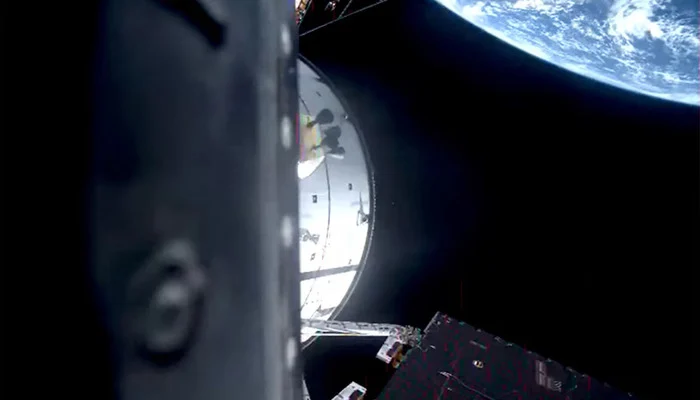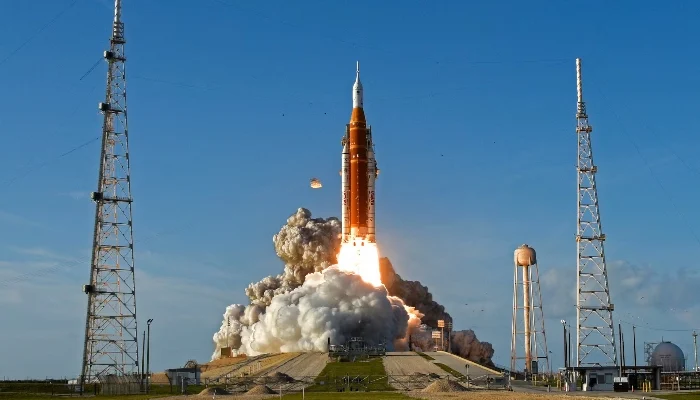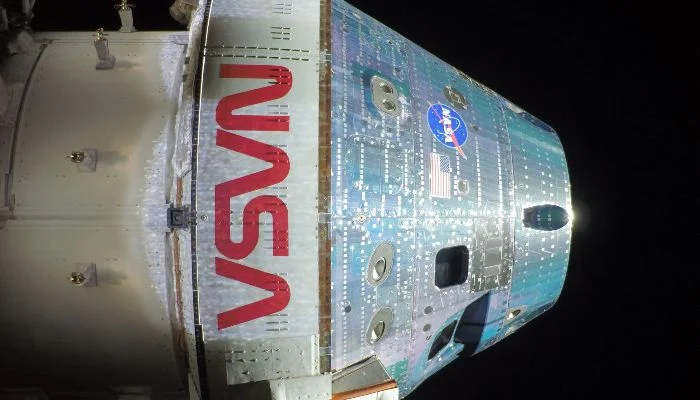

By midmorning Friday, the Artemis II crew was roughly 100,000 miles (160,000 kilometres) from Earth, rapidly approaching the Moon.
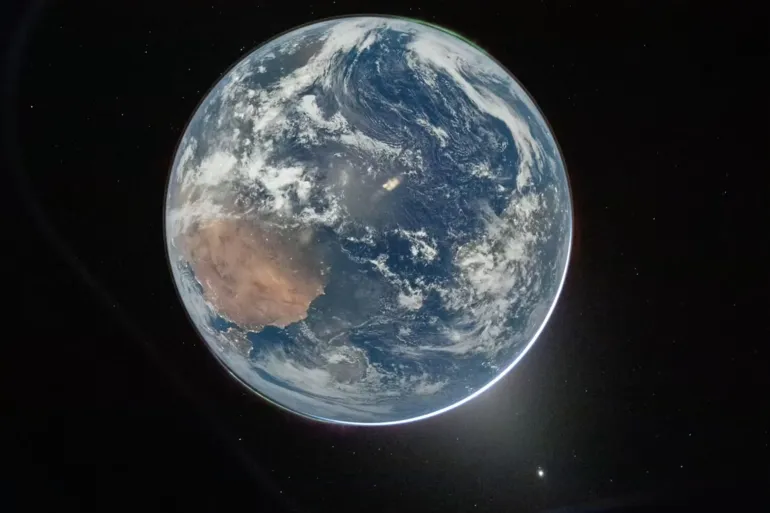
NASA has shared the first images from inside the Artemis II Orion spacecraft, where four astronauts are currently on a mission orbiting the Moon.
In one photo released Friday, mission commander Reid Wiseman captured Earth through the capsule’s window, showing the planet cloaked in swirling clouds as it appears to rise beyond the spacecraft during their journey.
Another image captures the entire Earth, with oceans in view and a faint green aurora glowing along the horizon.
By midmorning Friday, Wiseman and his crew were about 100,000 miles (160,000 kilometres) from Earth, closing in on the Moon with roughly 160,000 miles (258,000 km) remaining. They are expected to reach lunar orbit on Monday.
The mission’s crew—three American astronauts and one Canadian—will orbit the Moon in the Orion capsule before returning to Earth without landing. Their trajectory was set after firing Orion’s main engine Thursday night.
“I knew that this is what we would see,” mission specialist Christina Koch, the first woman to travel around the Moon, told ABC News in a video call Thursday night.
“But there’s nothing that prepares you for the breathtaking view of seeing your home planet both bright in daylight and illuminated by the Moon at night, with a beautiful beam of sunset. Knowing we’ll see similar views of the Moon is incredible. I’m really excited for that—and, of course, for the journey home,” she added.
On the sixth day of the mission, the crew will fly past the Moon, with the spacecraft reaching its closest approach—about 4,000 to 6,000 miles (6,450–9,650 km) above the lunar surface.
The astronauts will orbit the far side of the Moon, becoming the first humans to travel that far into deep space in over 50 years. Before reaching this phase, the crew are practicing the scientific observations they plan to conduct during the lunar flyby.
A flyby occurs when a spacecraft passes around a planet or moon without landing, using its gravity to alter its trajectory and head back toward Earth.
After circling the Moon, Orion will use lunar gravity to return home, with splashdown expected in the Pacific Ocean off the coast of San Diego on April 11 at approximately 00:06 GMT (8:06 p.m. ET on April 10).
For the astronauts, the mission is both technical and personal. Seeing Earth from deep space serves as a powerful reminder of humanity’s shared identity, said Victor Glover, the first Black astronaut to travel beyond low-Earth orbit.
“Trust us, you look amazing. You look beautiful,” Glover told ABC, describing the view of Earth. “From up here, you look like one thing. Homo sapiens is all of us—no matter where you’re from or what you look like. We’re all one people. We call amazing things that humans do ‘moonshots’ for a reason. This mission brought us together and showed us what we can achieve when we combine our differences and strengths to accomplish something great.”
About the Author