
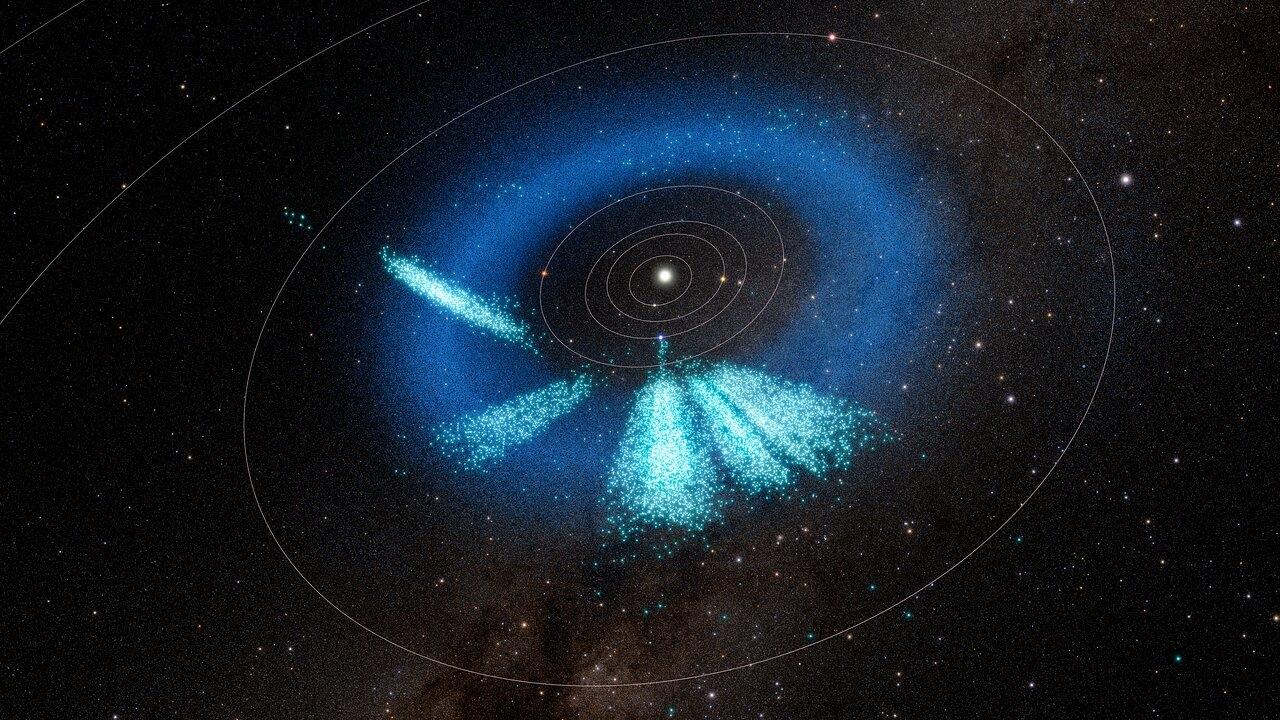
Scientists using the new Vera C. Rubin Observatory in Chile, home to the world’s largest camera, have discovered around 11,000 asteroids in the solar system. The discoveries include hundreds of distant objects beyond Neptune and 33 previously unknown near-Earth asteroids.
This remarkable total was achieved in just the past 1.6 years, demonstrating the observatory’s extraordinary detection capabilities even before its full operations begin later this year.
Jointly funded by the U.S. National Science Foundation and the Department of Energy’s Office of Science, the $473 million Rubin Observatory is located atop Cerro Pachón in Chile at 8,900 feet (2,700 meters), near the Gemini South Observatory.
Asteroid Discoveries
The Rubin Observatory’s asteroid tally includes 73 objects detected during early test observations in late 2024 using its Commissioning Camera. Another 1,514 were identified during the remarkable “first look” phase in April and May 2025. The largest share — over 11,000 asteroids — was found during early optimization surveys conducted in mid-2025. All discoveries have been confirmed by the International Astronomical Union’s Minor Planet Center.
Tantalizing Discoveries
In just six weeks of 2025, the Rubin Observatory recorded a staggering 91,000 asteroids across a million observations, including 11,000 new finds and 80,000 previously known objects. It also identified 380 trans-Neptunian objects — icy bodies orbiting beyond Neptune — including two, 2025 LS2 and 2025 MX348, whose farthest points lie 1,000 times farther from the Sun than Earth.
“Objects like these offer a tantalizing probe of the solar system’s outermost reaches, from revealing how the planets migrated early in its history to exploring whether a previously unknown ninth large planet might still exist,” said Kevin Napier, a research scientist at the Harvard-Smithsonian Center for Astrophysics, who developed algorithms to detect distant solar system objects using Rubin data.
Discovery Rate Accelerates
What makes these findings particularly remarkable is the speed of discovery. Almost all of the asteroids were detected even before the observatory’s primary survey, the Legacy Survey of Space and Time, officially began.
Once fully operational, the Rubin Observatory is projected to discover thousands of new asteroids each week, including roughly 90% of potentially hazardous asteroids larger than 140 meters that could come within seven million kilometers of Earth. It is also expected to detect more than 50 interstellar objects.
Breakthrough Technology
The Rubin Observatory’s mission is to produce a detailed time-lapse of the Southern Hemisphere sky, imaging it completely every three to four nights for 10 years. Its record-breaking asteroid discoveries are made possible by a powerful combination of hardware and software. The Simonyi Survey Telescope, with an 8.4-meter (27.6-foot) primary mirror and a field of view roughly as wide as seven full moons, along with the ultra-sensitive 3,200-megapixel LSSTCam imager valued at $168 million, enables rapid and repeated scans of vast sky regions.
Equally important are the advanced computational pipelines that sift through billions of light sources to detect moving objects. These systems can identify faint, fast-moving asteroids that traditional surveys would likely miss.
Planetary Defense and Scientific Insights
Among the thousands of discoveries are near-Earth objects (NEOs), which astronomers monitor closely for potential collision risks. While none of the newly detected objects currently pose a threat, the expanding dataset enhances scientists’ ability to track and predict asteroid trajectories. The Rubin Observatory is expected to uncover nearly 90,000 additional NEOs, some of which could be potentially hazardous.
Transformational Moment
Over the next decade, the Rubin Observatory is expected to triple the number of known asteroids, marking a monumental shift for astronomy. On February 24, Rubin recorded 800,000 cosmic events in a single night as it activated its near-real-time alert system, capturing everything from exploding stars to asteroids. Eventually, the system is projected to generate up to seven million alerts each night.
Tip of the Iceberg
“What used to take years or even decades to discover, Rubin will uncover in months,” said Mario Jurić, astronomy professor at the University of Washington and leader of Rubin’s solar system team. He noted that these discoveries are “just the tip of the iceberg” and that the observatory will “fundamentally reshape our inventory of the solar system and open the door to discoveries we haven’t yet imagined.”
About the Author