

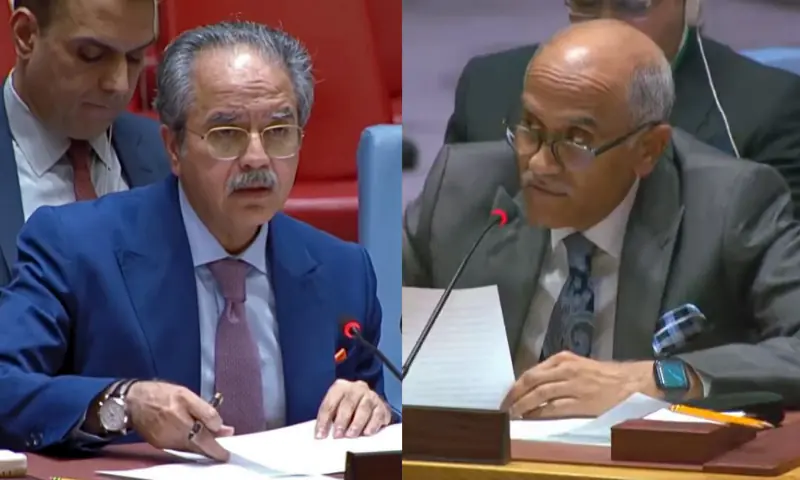
WASHINGTON: During a heated United Nations Security Council (UNSC) debate on Afghanistan on Monday, Pakistan strongly criticized India’s remarks on cross-border strikes, accusing New Delhi of being complicit in the terrorism threat along its western border.
Pakistan’s Permanent Representative to the United Nations, Ambassador Asim Iftikhar Ahmad, engaged in a sharp exchange with his Indian and Afghan counterparts after India accused Islamabad of “flagrant violations of international law” during the Pak-Afghan conflict.
During the UN Security Council session, India’s Permanent Representative Parvathaneni Harish said New Delhi “reiterates the UN Secretary-General’s deep concern over civilian casualties caused by cross-border violence and strongly condemns airstrikes that constitute flagrant violations of international law, the UN Charter and state sovereignty.”
India also voiced “grave concern over ‘trade and transit terrorism,’” warning that the vulnerabilities of landlocked developing countries should not be exploited or weaponised.
India a ‘spoiler’ in Afghanistan: Pak envoy
Pakistan’s Permanent Representative to the United Nations, Ambassador Asim Iftikhar Ahmad, strongly criticised India during the UN Security Council debate, calling New Delhi’s remarks “no surprise” given what he described as India’s longstanding hostility toward Pakistan and its alleged objective of destabilising the country through its Afghan policy.
Responding to comments by India’s envoy Parvathaneni Harish, Ambassador Ahmad accused India of “actively supporting and sponsoring terrorist groups operating from Afghan soil,” including Tehreek-i-Taliban Pakistan and the Baloch Liberation Army.
He said that while India’s representative had spoken extensively about Afghanistan’s security situation — citing civilian casualties and border clashes — there was no acknowledgement of the terrorist threat emanating from Afghan territory, which he alleged was due to India’s own involvement.
The Pakistani envoy added that Islamabad had presented “irrefutable evidence” of India’s collusion with militant groups responsible for attacks inside Pakistan.
“One can sense India’s pain in seeing its heavy investment in the Afghan terrorist franchise going to waste as a result of Pakistan’s precise and effective action against terrorist camps and support bases inside Afghanistan,” Ahmad said.
Addressing India’s accusations against Pakistan, he described India as “a serial violator of international law,” alleging that it had illegally occupied territory, violated the UN Charter and Security Council resolutions, carried out state terrorism in Indian-Occupied Kashmir and beyond, marginalised minorities, spread hate and weaponised water resources to harm Pakistan.
Ambassador Ahmad emphasised that Pakistan’s counter-terrorism operations were not directed against the people of Afghanistan but aimed at neutralising terrorist threats originating from Afghan territory. He said these actions were carried out in accordance with the right to self-defence and international humanitarian law.
In his concluding remarks, the envoy said India had “always played the role of a spoiler in Afghanistan,” while Pakistan had worked responsibly to promote peace, stability and prosperity in the country.
He added that lasting stability in Afghanistan would require the Taliban authorities to fulfil their commitments on counter-terrorism, inclusive governance and protecting the rights of Afghan women and girls.
Ahmad also urged India to “cease and desist” from what he described as attempts to foment terrorism in Pakistan from Afghan territory, warning that Pakistan would not allow such actions to threaten its security.
Afghan envoy ‘cut off from ground realities’
Pakistan’s Permanent Representative to the United Nations, Ambassador Asim Iftikhar Ahmad, also criticised remarks made by Naseer Ahmad Faiq, who serves as chargé d’affaires ad interim of Afghanistan’s permanent mission to the United Nations but is not formally recognised by the country’s de facto Taliban authorities.
Faiq had highlighted civilian casualties in the Pakistan–Afghanistan conflict and stressed the need to combat terrorism. However, he did not mention groups such as Al Qaeda or the Tehreek-i-Taliban Pakistan, which Pakistan says operate from Afghan territory.
Responding to his remarks, Ambassador Ahmad questioned their credibility, saying the “so-called representative of Afghanistan” did not represent the current authorities in Kabul and should not use the forum to pursue a personal agenda.
Describing Faiq as being “sequestered in New York,” Ahmad said the envoy was “completely cut off from ground realities” and had selectively commented on the situation, particularly in reference to Pakistan.
He added that Faiq had “nothing to say about cross-border terrorism from Afghanistan,” which, according to Pakistan, has resulted in significant casualties among civilians, members of the armed forces, law enforcement personnel and damage to infrastructure.
About the Author