
KSE-100 index reaches 158,189.66 points after gaining 2,012.54 points or 1.29%
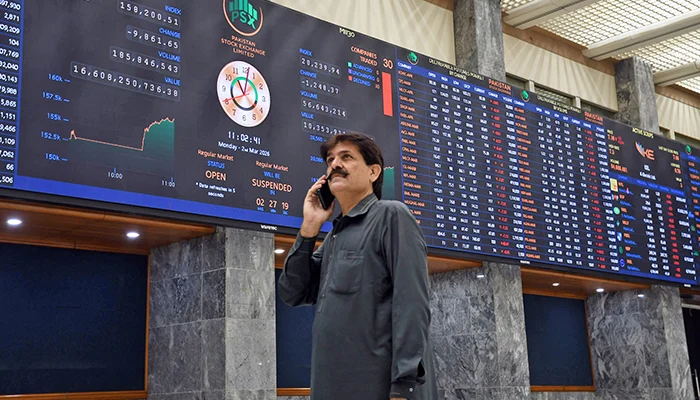
Stocks at the Pakistan Stock Exchange continued their upward momentum on Wednesday, with the benchmark index climbing more than 1,900 points amid declining oil prices and stronger investor confidence.
The KSE-100 Index rose by 2,012.54 points, or 1.29%, reaching 158,189.66 points. This increase came after the previous session’s close of 156,177.12, when the market recorded its second-highest single-day gain.
The rally followed the State Bank of Pakistan decision to keep the policy rate unchanged at 10.5%, a move that reassured investors and boosted risk appetite in the market.
Investor sentiment was further supported by improving global markets and falling oil prices. The decline in crude prices came after remarks from Donald Trump suggesting that tensions in the Middle East conflict could ease soon, reducing concerns over prolonged disruptions in energy supplies.
Ahfaz Mustafa, CEO of Ismail Iqbal Securities, told Geo.tv:
“Easing oil prices, proactive government measures, and attractive valuations are drawing investor attention.”
He added that market uncertainty and geopolitical tensions had previously triggered a correction of more than 20%, making stocks relatively cheap and dividend yields more attractive to investors.
Similarly, Ahsan Mehanti of Arif Habib Corporation said stocks extended their recovery in early trading at the Pakistan Stock Exchange, driven by institutional interest in oversold shares, lower global crude oil prices, and positive economic data showing $3.3 billion in remittances, up 5.2% year-on-year.
He added that government assurances about renegotiating its deal with the International Monetary Fund to reduce taxes, along with efforts to secure crude supplies during regional tensions, also acted as catalysts for bullish activity at the exchange.
Elsewhere in Asia, stocks in China and Hong Kong edged higher on Wednesday despite regional volatility, as investors shifted toward defensive sectors and increased bets on emerging energy industries.
Analysts at Huatai Futures noted that the conflict involving Iran appeared to be easing, supporting risk assets globally. “Chinese stock indices are benefiting from this positive momentum,” they said in a research note.
Meanwhile, global markets steadied after a brief pullback in oil prices, though investors remained cautious as mixed signals from the United States–Israel conflict involving Iran left markets uncertain about its potential impact on global inflation and economic growth.
Oil prices briefly declined after the International Energy Agency reportedly proposed the largest release of strategic oil reserves in its history, according to a report by The Wall Street Journal. The move aimed to ease crude prices and provide relief to global markets, though currencies and bonds showed little change.
Benchmark Brent crude futures traded 0.2% higher at $87.89 per barrel, while West Texas Intermediate crude remained largely unchanged at $83.47 per barrel, after initially falling on the news.
However, tensions in the Middle East continued to keep investors on edge as United States and Israel carried out heavy airstrikes against Iran, which some observers described as among the most intense attacks of the conflict, dampening earlier hopes of an imminent de-escalation.
About the Author