

An Oxford-led team has discovered a sulfur-rich exoplanet with a massive magma ocean, located 35 light-years away, challenging existing planet classifications.
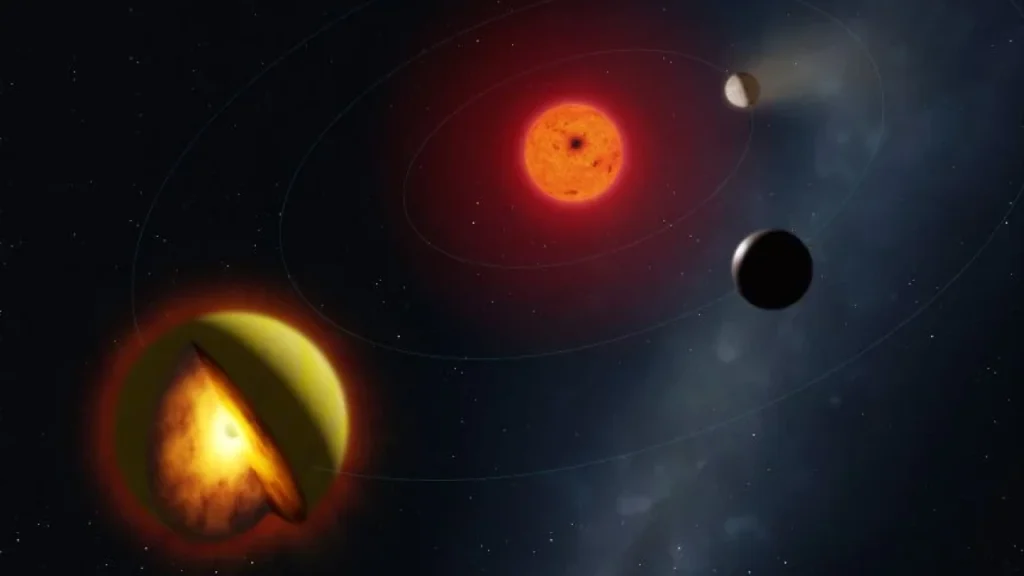
Scientists have identified a new type of exoplanet, L 98-59 d, featuring sulfur-rich magma oceans and located roughly 35 light-years from our solar system.
Unlike typical classifications—small rocky planets or large gas giants—L 98-59 d doesn’t fit neatly into either category.
The planet is about 60% larger than Earth but bears little resemblance to it. Researchers note that L 98-59 d has a much lower density than Earth and differs markedly from gas giants like Jupiter and Saturn.
Oxford-led study uncovers a sulfur-rich exoplanet challenging traditional planet classifications
An artist’s impression shows L 98-59 d orbiting its host, the red dwarf star L 98-59.
Photo by: Mark A. Garlick / markgarlick.com
By: Justin Boggs | Posted 11:24 PM, Mar 17, 2026
A team led by the University of Oxford has identified a new type of exoplanet, L 98-59 d, featuring sulfur-rich magma oceans and located about 35 light-years from our solar system.
While planets are typically classified as either small, rocky worlds or large gas giants, L 98-59 d does not fit neatly into either category.
The planet is roughly 60% larger than Earth but differs significantly in composition. Scientists report that L 98-59 d has a much lower density than Earth and contrasts sharply with gas giants like Jupiter and Saturn.
L 98-59 d possesses a hydrogen-rich atmosphere rich in sulfur gases, and its surface is believed to be dominated by a molten silicate mantle extending deep into the planet.
Researchers believe L 98-59 d’s vast magma ocean has stored large amounts of sulfur over billions of years, giving rise to its distinctive atmosphere. They also suggest that chemical reactions between the molten surface and radiation from the host star may contribute to the planet’s sulfur-rich composition.
The planet may have once resembled Neptune but gradually cooled and lost part of its atmosphere, evolving into its current state.
“What’s exciting is that we can use computer models to uncover the hidden interior of a planet we will never visit,” said Raymond Pierrehumbert, professor of physics at the University of Oxford, in a press release. “Although astronomers can only measure a planet’s size, mass, and atmospheric composition from afar, this research shows it is possible to reconstruct the deep past of these alien worlds—and discover types of planets with no equivalent in our own solar system.”
About the Author