
Kenya-Jade Pinto’s film, premiering at CPH:DOX in Copenhagen, takes viewers inside what she describes as “a global black box of migration, surveillance, and control.”
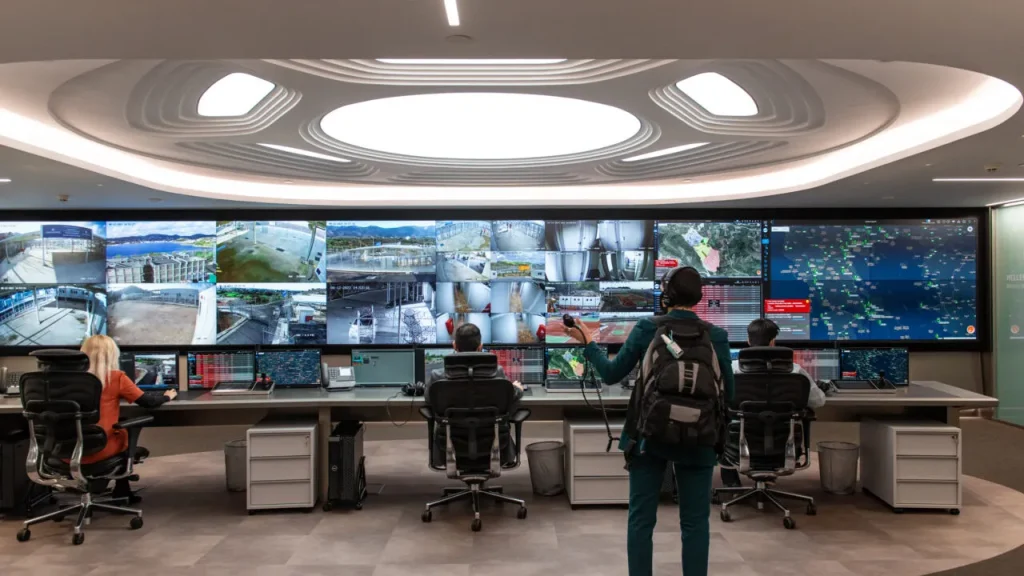
In The Sandbox, everyone can be digitized and easily discarded. The documentary by Kenya-Jade Pinto explores advanced technologies, including artificial intelligence, and their role in surveillance, power politics, and border control amid global debates over migration.
The Sandbox will have its world premiere in the main competition at the 23rd edition of the Copenhagen International Documentary Film Festival (CPH:DOX) on Tuesday, March 17.
According to the festival’s website, “Director Kenya-Jade Pinto offers a powerful look into a global black box of migration, surveillance, and control — as well as the mindset of those responsible for it.”
The film takes audiences from arms fairs in the United States to the southern borders of the European Union and beyond. It presents a timely and relevant examination of modern security systems, combining sharp political analysis with striking visuals from a world of drones and infrared cameras.
Despite its focus on technology and security policies, the documentary keeps the life and dignity of individuals at its center, mapping the tensions of the 21st century and revealing a global network of high-tech militarization where fear and power often reinforce one another.
The festival describes The Sandbox as “a clear-eyed snapshot of a world undergoing radical change.” The film is produced by Shasha Nakhai and Kenya-Jade Pinto, with cinematography by Luc Forsyth, Gabriela Osio Vanden, Pinto, and Nick Wambugu. Jordan Kawai serves as editor, while Together Films is handling sales.
The documentary travels from the Arizona desert to the drone-patrolled Mediterranean, meeting migrants, rescue workers, and border control agents along the way.
According to the synopsis, “Tools tested at borders increasingly spread into databases and everyday life, shrinking the distance between the watcher and the watched.” Rather than focusing on a single villain, the film highlights the systems, processes, and protocols that shape modern surveillance and migration control.
The festival describes The Sandbox as “a clear-eyed snapshot of a world undergoing radical change.” The film is produced by Shasha Nakhai and Kenya-Jade Pinto, with cinematography by Luc Forsyth, Gabriela Osio Vanden, Pinto, and Nick Wambugu. Jordan Kawai serves as editor, while Together Films is handling sales.
The documentary travels from the Arizona desert to the drone-patrolled Mediterranean, meeting migrants, rescue workers, and border control agents along the way.
According to the synopsis, “Tools tested at borders increasingly spread into databases and everyday life, shrinking the distance between the watcher and the watched.” Rather than focusing on a single villain, the film highlights the systems, processes, and protocols that shape modern surveillance and migration control.
I became curious about what was happening globally in this largely unregulated and opaque space where technology and migration intersect. That curiosity led me to begin unraveling what has become a vast global surveillance network.”
One key takeaway from The Sandbox is that technology is not as neutral as we often assume.
“Absolutely,” Pinto said. “We are the ones creating the technology that surrounds us. In the film, a couple of lines capture this idea well — one of them is that everything has a by-product. That raises an important question: what does that really mean, and what are the consequences?”
“There is also extensive research on the impact of bias in technology and coding. But ultimately, technology is a tool, and what truly matters is how we choose to use that tool—or not use it. That choice reveals the underlying motivations behind the technology, and that’s something the film explores across different contexts.”
When asked whether The Sandbox should be seen as a political film, Pinto said the idea evolved during production.
“While making the film, we often asked ourselves: is this really a tech story? At one point I realized that I wasn’t trying to tell a story about technology itself. This is actually a story about power. Once we understand how tools like AI connect to systems of power, we can start to break them down and examine them more critically.”
She added that the process of making the film involved navigating many complex actors and technologies, which can sometimes feel overwhelming. “But if we step back and look at the bigger picture, we see that these technologies are simply tools that reflect structures of power. And when we recognize that, we also realize we have the ability to question and challenge how they are used.”
The film travels across the U.S., the EU, and parts of Africa. How global are the issues explored in The Sandbox, and how much influence do traditional power centers such as the U.S. and the EU hold in this space?
“When we visit Kenya in the film, we hear how the digital labor of migrants helps sustain this system. It reflects a kind of modern-day colonialism, where people are effectively mined for their labor, their biometric data, and their personal information. That clearly points to an existing global power structure.”
“But with this film, we didn’t want to portray a single villain — not one person, corporation, or institution as the sole problem. Instead, we wanted to highlight that the system is sustained through widespread participation. Many different actors contribute to it, including institutions that are traditionally seen as liberal or progressive.
My hope is that audiences leave the film thinking more critically — not only about the current political moment. For instance, when we were filming in the United States, it was during the previous administration, and these developments were already steadily progressing.
The goal is to encourage people to reflect on the global system we have all helped create, and to question whether it truly works. Perhaps it’s time to think about new ways of organizing our societies and consider how we can challenge or reshape the existing order.”
I also hope the film has a timeless quality — something that encourages people to reflect on bigger questions about the kind of lives we want to lead and the future we want for our world.
Do you think The Sandbox will resonate more with people who share certain political beliefs?
I hope it connects with audiences across the political spectrum. Of course, the film has its own perspective, but it also offers a universal experience that invites viewers to engage and reflect. If people approach it with an open mind, I believe it can lead to meaningful insights.
What excites me most are the conversations it could spark. The film isn’t about blaming anyone; instead, it encourages audiences to pause and question whether the systems around us are truly working — and whether we are comfortable with the way things are.
How did you come up with the title The Sandbox?
I actually knew it pretty early on. It started as the working title and it stuck, partly because it’s a nod to how tech companies test new tools — they “sandbox” them. The sandbox is a space for play and experimentation, so it felt like a perfect metaphor for the film.
Are you working on any new film projects?
I’m hoping my next project will be in fiction, based on a book I’m developing. It will give me the chance to explore creativity in a different way. But at the heart of everything I do, I’m drawn to exploring the nuances of how we connect to each other in a world that’s constantly evolving.
How did you come up with the title The Sandbox?
I actually knew it pretty early on. It started as the working title and it stuck, partly because it’s a nod to how tech companies test new tools — they “sandbox” them. The sandbox is a space for play and experimentation, so it felt like a perfect metaphor for the film.
Are you working on any new film projects?
I’m hoping my next project will be in fiction, based on a book I’m developing. It will give me the chance to explore creativity in a different way. But at the heart of everything I do, I’m drawn to exploring the nuances of how we connect to each other in a world that’s constantly evolving.
About the Author