
Talks led by Scott Bessent and He Lifeng to focus on US tariff changes and China’s rare earth exports
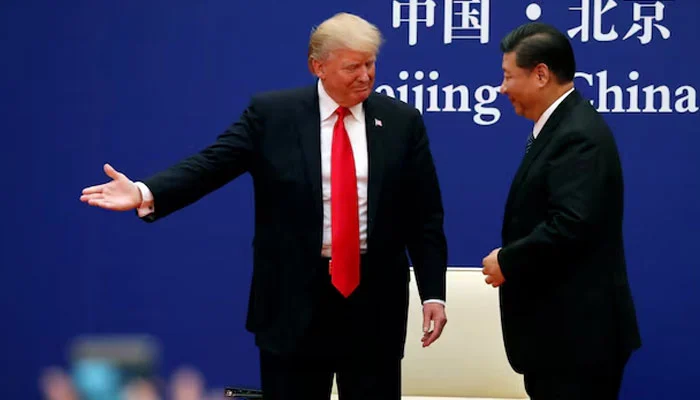
PARIS: Senior US and Chinese economic officials are scheduled to hold a new round of talks in Paris on Sunday to resolve outstanding issues in their trade agreement and pave the way for US President Donald Trump’s upcoming visit to Beijing to meet Chinese President Xi Jinping at the end of March.
The discussions, led by US Treasury Secretary Scott Bessent and Chinese Vice Premier He Lifeng, are expected to address US tariff adjustments, the supply of Chinese-produced rare earth minerals and magnets to US buyers, American high-tech export controls, and Chinese purchases of US agricultural goods.
PARIS: US and Chinese economic officials are scheduled to meet at the Paris headquarters of the Organisation for Economic Cooperation and Development, a source familiar with planning said. Although China is not a member of the 38-nation group of mostly wealthy democracies and considers itself a developing country, the talks continue a series of meetings held in European cities last year to ease tensions that nearly threatened trade between the world’s two largest economies.
US Trade Representative Jamieson Greer will also participate. Analysts say that with limited preparation time and Washington’s focus on the US-Israeli conflict with Iran, prospects for a major trade breakthrough—either in Paris or at the upcoming Beijing summit—remain modest.
“Both sides, I think, have a minimum goal of having a meeting, which keeps things together and avoids a rupture or renewed tensions,” said Scott Kennedy, a China economics expert at the Centre for Strategic and International Studies.
While President Donald Trump may hope to secure Chinese commitments to buy new Boeing aircraft and increase US liquefied natural gas and soybean purchases, Kennedy noted that achieving this might require concessions on US export controls. He added that a summit could end up “superficially suggesting progress” while leaving the underlying issues largely unresolved.
Trump and Xi Jinping may meet up to three additional times this year, including at the China-hosted APEC summit in November and the US-hosted G20 summit in December, which could provide more concrete results.
Iran war and oil concerns
The US-Israeli conflict with Iran is expected to be discussed in Paris, particularly regarding rising oil prices and the closure of the Strait of Hormuz, through which China receives 45% of its oil. On Thursday, Bessent announced a 30-day waiver of sanctions to allow the sale of stranded Russian oil, aiming to increase supply. On Saturday, Trump urged other nations to help protect shipping in the Strait after Washington bombed Iranian targets on Kharg Island and Iran threatened retaliation.
China’s state-run Xinhua news agency said meaningful progress in US-China economic cooperation could restore confidence in the fragile global economy.
Trade truce
The talks are expected to review progress under the October 2025 trade truce agreed by Trump and Xi in Busan, South Korea. The agreement averted a major flare-up, reduced US tariffs on Chinese imports, paused China’s export controls on rare earths for a year, and halted expansion of a US blacklist on Chinese high-tech buyers. China also committed to purchasing 12 million metric tons of US soybeans in 2025 and 25 million tons in 2026.
US officials, including Bessent, say China has largely met its Busan commitments, citing soybean purchases. However, while some industries receive Chinese rare earth exports, US aerospace and semiconductor companies face worsening shortages of materials like yttrium, essential for heat-resistant coatings on jet engines.
“US priorities at the Paris talks will likely focus on agricultural purchases and greater access to Chinese rare earths in the short term,” said William Chou, a senior fellow at the Hudson Institute.
Trade probes
Greer and Bessent will also address a new “Section 301” investigation into unfair trade practices, targeting China and 15 other countries over alleged industrial overcapacity. A similar probe addresses forced labor in 60 nations, including China, which could lead to import bans.
The investigations aim to restore Trump-era tariff leverage after the US Supreme Court struck down his global tariffs under an emergency law, which had effectively cut tariffs on Chinese goods by 20 percentage points. Trump subsequently imposed a 10% global tariff under a different trade law. China condemned the probes on Friday, reserving the right to retaliate. State-run China Daily described the actions as unilateral and complicating negotiations.
“The new round of talks is both an opportunity and a test,” Xinhua news agency said, adding: “Whether progress can be achieved depends largely on the US side. Washington must approach the talks rationally and pragmatically, in line with principles that support stable China-US economic relations.”
About the Author