
Why Cats Always Land on Their Feet: Scientists Explain the Amazing Cat Righting Reflex
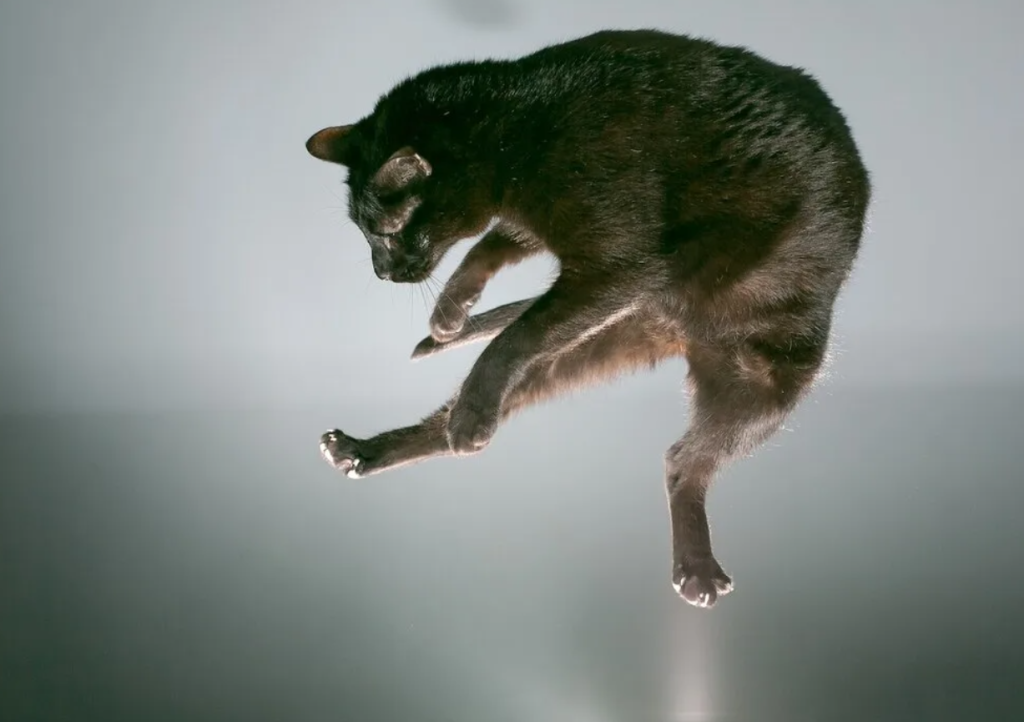
It looks like magic—but it’s actually pure biomechanics. When a cat falls, it quickly twists its body in midair and lands safely on its paws. To humans, this ability seems like a small miracle. For cats, however, it’s a crucial survival instinct.
This remarkable ability, known as the cat righting reflex, has fascinated scientists for decades. Now, researchers from Yamaguchi University in Japan have provided new insights into how cats perform this seemingly impossible maneuver. Their findings were published in the scientific journal The Anatomical Record.
The “Impossible” Physics of a Falling Cat
According to basic physics, a body cannot change its orientation in space without an external force. In theory, if something begins falling while spinning, it shouldn’t be able to simply reorient itself.
Yet cats do exactly that.
While falling, a cat can rotate its body in midair—without pushing off anything. This ability is called the air-righting reflex, and it allows cats to twist their bodies in a fraction of a second so their paws face the ground before landing.
The Hidden Role of the Cat’s Spine
To understand this phenomenon, researchers studied the structure and movement of a cat’s spine in detail. What they discovered may surprise many people.
A cat’s spine is not just a single, extremely flexible “rubber band.” Instead, different sections of the spine perform specialized functions during a fall. The thoracic spine (upper back) and the lumbar spine (lower back) work together in a coordinated way, allowing the cat to twist its body and control its rotation midair.
This unique spinal flexibility—combined with precise muscle control and a highly developed sense of balance—allows cats to perform one of the most impressive survival tricks in the animal kingdom.
How Scientists Studied the Cat Righting Reflex
To better understand how cats manage to land on their feet, researchers at Yamaguchi University conducted a detailed biomechanical study of the feline spine.
First, the team examined the spines of five deceased cats. They carefully separated the thoracic spine (upper and middle back) and the lumbar spine (lower back) and applied controlled twisting forces to each section. This allowed the scientists to measure how flexible or rigid each part of the spine really is.
In addition to these laboratory tests, the researchers also studied real falling movements. Two healthy cats were filmed using high-speed cameras as they fell in a controlled environment onto a soft cushion. Small markers were placed on their shoulders and hips so that every movement during the fall could be tracked with precision.
The Sequence of a Cat’s Midair Rotation
The results revealed a fascinating biomechanical process.
The thoracic spine, located in the upper and middle back, proved to be extremely flexible. Researchers found it contains a “neutral zone,” meaning it can twist up to about 50 degrees with very little resistance.
In contrast, the lumbar spine in the lower back is much stiffer and more stable.
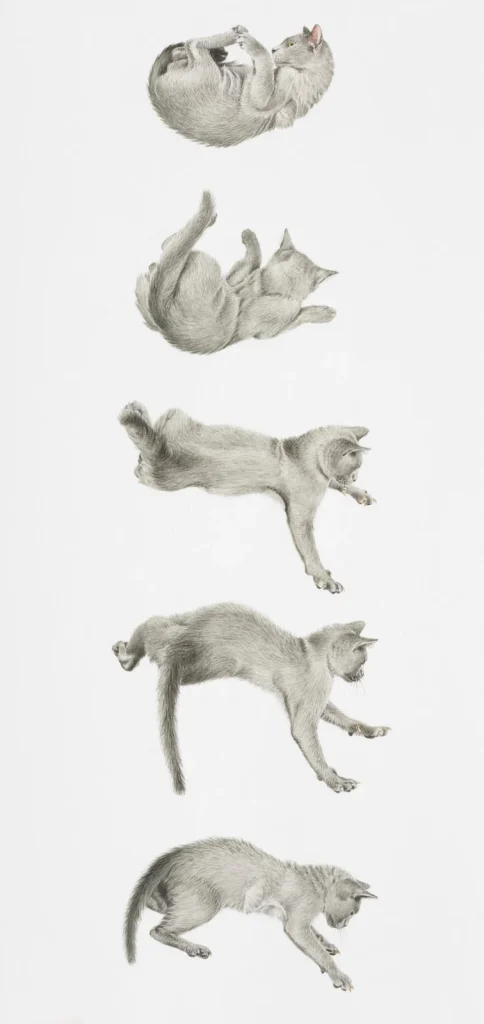
This difference in flexibility appears to be the secret behind a cat’s famous landing ability. When a cat falls, the front part of its body rotates first thanks to the flexible thoracic region. The rest of the body then follows in a coordinated motion, allowing the cat to reorient itself in midair and prepare for a safe landing.
During the fall, the following happens:
- First, the cat turns its head and front body toward the ground–made possible by the enormous flexibility of the thoracic spine–and the lighter weight of the front half of the body.
- Only then does the rear body section follow–the more stable lumbar spine acts like an anchor, preventing the cat from spinning uncontrollably.
The authors note that the rotation occurs “sequentially”: first the front, then the rear torso section–and that the flexible thoracic and torsion-stable lumbar spine are optimally adapted to this behavior. In other words, the cat doesn’t just “tie itself in knots” in the air–it strategically uses two differently functioning spinal sections.
Not Magic–But Perfect Evolution
From a behavioral biology perspective, this is unsurprising–yet fascinating. Cats are natural climbers. Whether it’s a tree, wall, or bookshelf: Height is part of their daily life. An efficient spinning reflex was thus a significant survival advantage.
It’s also interesting that the movement is not chaotic but highly coordinated. The body doesn’t work as a rigid unit but as a finely tuned system with clearly distributed functions.
Significance Beyond the Cat
The findings are not only intriguing for cat owners. According to the researchers, the data could help,
- improve mathematical models of animal movement,
- advance therapies for spinal injuries in veterinary medicine,
- and even construct more flexible robots.2
Conclusion: The Secret of the Spin Lies in the Spine
Cats don’t “magically” land on their paws. They use a biomechanically sophisticated strategy: an extremely flexible thoracic spine combined with a stabilizing lumbar spine–and a precisely timed spinning motion.
What looks like a small miracle to us is actually the result of perfect anatomical adaptation. Or put another way: The next time your cat elegantly jumps off a shelf, feel free to be impressed. Its spine is performing at its best.
About the Author