

A research team from YOKOHAMA National University has developed a novel α-allylation reaction using simple ketones and allyl alcohols, opening new possibilities for next-generation catalyst design. Their findings were published in ACS Catalysis on March 2, 2026.
Allylation is a key organic reaction that introduces an allyl group into a molecule, altering its molecular structure and properties. Such reactions are critical in synthesizing pharmaceuticals and agrochemicals. Professor Ken Motokura explained that “this study aimed to enable the allylation of simple ketones using allyl alcohols as the allylating agent. Simple ketones and allyl alcohols are among the least reactive nucleophiles and allylating agents, making their direct coupling highly challenging.”
Previous research largely focused on allylation with reactive leaving groups like allyl halides, acetates, or carbonates. Few studies had explored using less reactive allylic alcohols. The team built on prior work showing that placing multiple catalytically active species with defined structures on solid surfaces can accelerate reactions through cooperative effects.
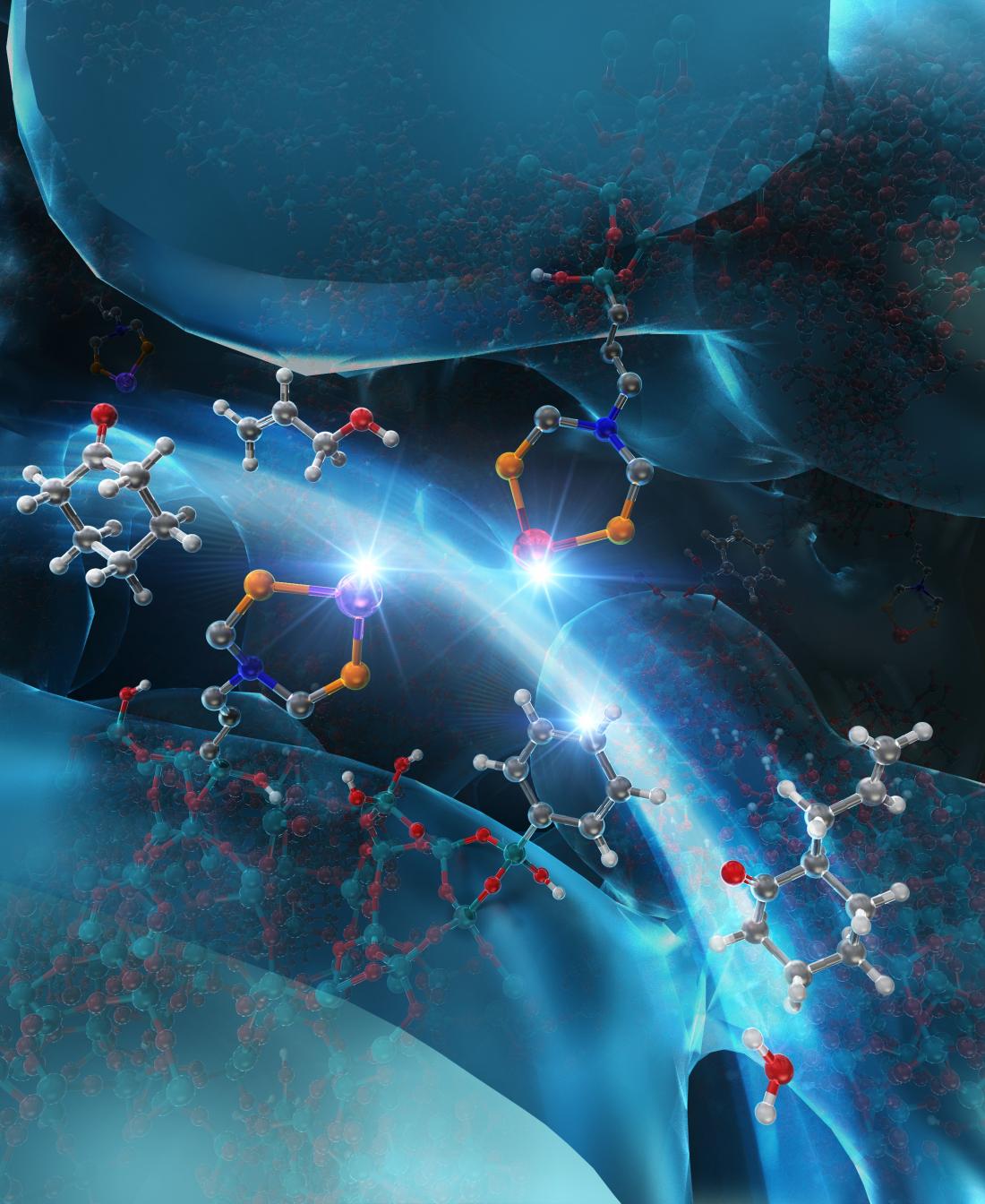
In this study, the researchers designed a multifunctional catalyst by co-immobilizing palladium and copper complexes on mesoporous silica. This enabled simultaneous activation of ketones and allyl alcohols, efficiently promoting α-allylation. The addition of organic functional groups, such as phenyl groups, on the silica surface further amplified catalytic activity.
Compared with catalysts containing only palladium complexes, the co-immobilized palladium–copper catalyst improved overall activity by up to 15.5 times. Professor Motokura noted, “Co-immobilizing palladium and copper complexes with organic functional groups markedly accelerated the reaction between simple ketones and allyl alcohols.”
The team demonstrated the catalyst’s versatility across various carbonyl compounds and confirmed its reusability through three recycling tests using indanone, achieving a total palladium turnover number of 600. Spectroscopic analyses, isotope-labeling experiments, and density functional theory calculations indicated that the copper complex activates the ketone, while organic functional groups optimize the spatial arrangement of metal complexes to promote the reaction.
This approach, introducing multiple structurally well-defined catalytic species onto solid surfaces, represents a new design principle distinct from conventional strategies like active-site control or ligand design. Motokura added, “To our knowledge, this is the first heterogeneous catalyst developed for the allylation of simple ketones with allyl alcohols. In the future, combining palladium and/or copper complexes with chiral ligands could enable highly efficient enantioselective allylation.”
The study highlights that arranging multiple active sites within mesoporous channels can significantly accelerate challenging catalytic transformations. “Rather than relying solely on metal selection or ligand design, spatial accumulation of active sites can serve as a generalized principle for next-generation catalysts,” said Motokura.
The research team includes Shunichi Sakai, Shingo Hasegawa, and Ken Motokura. Funding was provided by Grants-in-Aid for Scientific Research and Early-Career Scientists from the Japan Society for the Promotion of Science.
YOKOHAMA National University is a leading research institution in Japan, advancing studies in fields including AI, robotics, quantum information, biotechnology, and sustainable urban development, while fostering global collaboration and interdisciplinary innovation.
About the Author