

Artemis II’s four astronauts returned to Earth on Friday, splashing down in the Pacific Ocean off the coast of California aboard their gumdrop-shaped Orion spacecraft.
Their dramatic return marked the conclusion of the first crewed mission to the Moon since 1972—ending a 54-year gap.
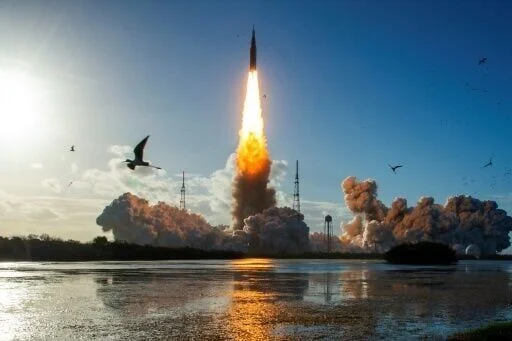
The $4.1 billion lunar mission, launched on April 1 from Florida, traveled farther than humans have ever gone before and captured detailed images of the Moon’s far side.
The mission also drew significant global attention, with large audiences following Artemis II’s launch, lunar journey, and the splashdown of the Integrity spacecraft.
“Artemis II truly feels like a turning point. We have not sent astronauts beyond low Earth orbit since the Apollo era. Just flying around the Moon again is significant on its own,” said Darsa Donelan, a physicist and mathematician specializing in space science at Gustavus Adolphus College in Minnesota.
“However, what stands out to me this time is the goal. It is not just about returning once as part of a space race. It is about finding ways to stay and work in space,” Donelan added.
‘SO COOL’
The Artemis II mission and its crew also created moments of excitement and connection across the country, offering a contrast to ongoing stresses, divisions, and conflicts in society.
“It’s just so cool. When are you ever going to have pictures from the far side of the Moon?” said Angela Des Jardins, a solar physicist at Montana State University and director of the Montana Space Grant Consortium and the NASA Established Program to Stimulate Competitive Research (EPSCoR) in Montana.
The latter two programs support students in pursuing education and careers in space exploration, as well as research and development that can benefit from space missions.
Des Jardins highlighted the recently completed mission and its potential research and practical applications, particularly in areas such as satellite technology and radiation studies.
Donelan also pointed to the broader scientific potential, including future space exploration.
“There is also a lot of interest in water ice on the Moon. If we could use that for fuel or life support, it would be a complete game changer. The Moon will not be the finish line for crewed missions, but the launch pad for future journeys,” Donelan said.
The Artemis mission serves as a precursor to a planned Moon landing in 2028 and the establishment of a permanent U.S. lunar base, while also laying the groundwork for future missions to Mars.
‘A NEW ERA’
The Montana and Minnesota physicists also highlighted the significance of the Artemis II crew, which includes Americans Reid Wiseman, Victor Glover, and Christina Koch, along with Canadian astronaut Jeremy Hansen.
Koch previously lived in Livingston, Montana, near Bozeman, before joining NASA’s astronaut corps. She grew up in Jacksonville, North Carolina, dreaming of becoming an astronaut and earned both her undergraduate and graduate degrees from North Carolina State University. She is also the first woman assigned to a lunar mission.
Des Jardins said Koch’s local ties and groundbreaking role in exploration help inspire and connect with students in Montana and across the United States.
“That really means a lot,” she said.
Donelan agreed, adding that Glover is the first person of color to take part in a crewed Moon mission.
“This really feels like a new era of space exploration. We are not just going farther out; we are doing it in a way that represents more of humanity,” Donelan said.
‘POINT OF PRIDE’
Work, training, testing, and technology tied to the Artemis mission extend across the United States.
“It’s the ultimate team sport,” said Adam Klein, a U.S. Navy captain and instructor at the U.S. Naval Test Pilot School (USNTPS) at Naval Air Station Patuxent River in southern Maryland.
Klein said Artemis and other missions could not succeed without the extensive network of mission control teams, engineers, testers, trainers, and support staff behind them. He added that he has worked with and flown alongside all four members of the Artemis II crew. Wiseman and Glover both served in the U.S. Navy.
He noted that the Maryland test pilot school has been training astronauts for decades, including since the Apollo era, and its pilots and instructors have contributed to spacecraft and capsule testing—work that also supported the Artemis II mission.
“We have evaluated the Orion capsule design,” Klein said, adding that he and the Naval Test Pilot School assisted with launch testing.
Since NASA does not operate its own pilot training school, it partners with the U.S. military for astronaut preparation, including training for lunar landing simulations such as vertical landing exercises at Patuxent River.
Klein described Artemis as a “point of pride” for those involved in astronaut training, expressing hope that Artemis II will provide “a big shot in the arm” for space exploration and related programs.
“We push the boundaries of human exploration. They are the best of humanity. They truly bring all of humanity together,” he said.
UNDER THE SEA
Artemis is named after the Greek goddess of the Moon, wildlife, and chastity, and she is the twin sister of Apollo, after whom NASA’s earlier Moon missions in the 1960s and 1970s were named.
Two Artemis astronauts—commander Reid Wiseman and Canadian mission specialist Jeremy Hansen—also trained at Florida International University’s Aquarius Reef Base, an underwater research laboratory in the Florida Keys.
The Aquarius facility helps astronauts simulate the isolation and confinement of spaceflight. Through a partnership with NASA, astronauts live and work underwater for extended periods to prepare for missions in space.
SUPPLY CHAINS
NASA’s Artemis program is a major and costly undertaking, with the most recent Moon mission priced at $4.1 billion and the overall long-term program expected to approach $100 billion.
More than 2,700 contractors and suppliers contribute parts, technologies, and materials to support the Artemis initiative.
Key companies involved include Lockheed Martin, the prime contractor for the Artemis II Orion spacecraft, as well as SpaceX and Blue Origin, founded by Elon Musk and Jeff Bezos respectively.
Several firms supplied multiple components and technologies for the lunar mission.
Aerojet Rocketdyne, a division of L3Harris Technologies, provided 108 components for Artemis II, including engines used during liftoff and avionics systems, according to Mary Engola, the company’s director of space communications.
Engola said that the work is carried out across multiple locations, including Washington state, California, Ohio, and Florida.
Northrop Grumman built the rocket boosters for the Artemis II mission in Promontory, Utah. The company also manufactures rocket motors at facilities in Elkton, Maryland, and Magna, Utah.
Honeywell, which operates across states including North Carolina, Minnesota, and Florida, is supplying 14 different products for the Artemis missions, ranging from navigation and data systems to display controls and flight software.
Two additional Minnesota-based companies also contributed to the latest NASA mission. Winona-based Midwest Metal Products cast eight large metal cylinders used in the transporter that carried the Space Launch System (SLS) rocket to the launch pad.
Eden Prairie-based Stratasys produced 3D-printed thermoplastic components for Lockheed Martin’s Orion spacecraft.
SOCIAL MEDIA MISSION
Artemis II also marked the first Moon mission in the social media era, enabling widespread engagement across digital platforms and the sharing of photos and videos from the journey, including striking images of the far side of the Moon.
“We need public support,” said Klein, referring not only to funding but also to enthusiasm for space exploration. “This has the power to truly inspire people.”
Des Jardins also highlighted the impact of social media, pointing to the release of far-side lunar images and astronauts’ use of smartphones during the mission.
“They are the first astronauts who got to take their smartphones into space,” she said.
About the Author