
Ten years ago, Leicester City were on the brink of one of the greatest Premier League triumphs in history. Next season, they will be playing in League One.
The club has suffered a steep decline since lifting the FA Cup in 2021, with Tuesday’s 2-2 draw against Hull City confirming their relegation to England’s third tier.
From the remarkable 5,000-1 Premier League title win that stunned world football, to the tragic loss of owner Vichai Srivaddhanaprabha in a helicopter crash two years later, Leicester have experienced a turbulent decade filled with extreme highs and lows.
In 2016-17, the club reached the Champions League quarter-finals against Atlético Madrid. Now, just years later, they find themselves preparing to compete against teams like Bromley—clubs with deep non-league histories.
The rapid decline
After finishing eighth in the Premier League in 2022 and reaching the Europa Conference League semi-finals, then-manager Brendan Rodgers warned that the club needed to reset its expectations.
The financial impact of Covid-19 hit hard, particularly on King Power, the duty-free business owned by the Srivaddhanaprabha family, as global travel halted. The effects continued to ripple through the club.
Following a winless start to the 2022-23 season, Rodgers shifted focus to survival, stating that reaching 40 points should be the priority—far removed from earlier ambitions of challenging the Premier League elite.
That change marked a stark contrast to his earlier tenure, when he spoke openly about Leicester disrupting the established top-six order. Under his leadership, they had come close to Champions League qualification in back-to-back seasons and won the FA Cup by beating Thomas Tuchel’s Chelsea.
However, a lack of sustained investment and growing instability soon accelerated the club’s decline.
Instability and managerial turnover
Despite still having experienced players such as Jamie Vardy, James Maddison, and Youri Tielemans, Rodgers was dismissed in April 2023 with Leicester in the relegation zone. Dean Smith replaced him but was unable to prevent the drop.
Since Rodgers’ departure, Leicester have appointed seven different managers, with growing questions over the club’s decision-making and lack of clear identity.
The managerial carousel has included Enzo Maresca—who did deliver the Championship title in 2024—followed by Steve Cooper, then Ruud van Nistelrooy, who managed just five wins in 27 games.
Marti Cifuentes took over in July, with Van Nistelrooy finally dismissed after the club entered a new financial year. Cifuentes was expected to rebuild a struggling squad but was sacked in January while Leicester sat 14th, just six points off the play-offs.
That decision has since been heavily questioned, especially given the delay in appointing a replacement. Gary Rowett eventually arrived 24 days later, despite being dismissed by relegation rivals Oxford United only a month earlier.
Further collapse and unrest
Under Rowett, results deteriorated further. A six-point deduction for breaching EFL financial rules in February left Leicester hovering above the relegation zone only on goal difference.
Sources have described a “we will be fine” mentality within the club, echoing attitudes seen during their Premier League relegation in 2023.
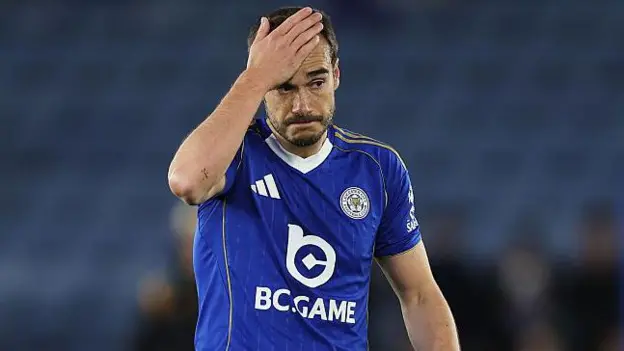
Performances have continued to disappoint, with insiders reportedly shocked by the display in Saturday’s defeat at Portsmouth. Tensions spilled over afterward, as midfielder Harry Winks became involved in an incident with frustrated supporters while boarding the team coach.
Winks, a 10-cap England international, was also booed when he came on as a substitute against Hull, underlining the growing disconnect between the squad and the fanbase.
The impact of the owner’s death
The death of Vichai Srivaddhanaprabha had a profound impact on Leicester City, and the club is still dealing with its long-term consequences. Vichai tragically died in a helicopter crash outside the King Power Stadium following a draw with West Ham—an event that deeply shook the club on and off the pitch.
Vichai purchased Leicester for £39 million in 2010, cleared the club’s debts, and guided them back to the Premier League four years later. Under his ownership, Leicester went on to win the Premier League title in 2015-16, completing one of the most extraordinary sporting achievements in history.
“He was so influential,” said defender Robert Huth, a key member of that title-winning squad. “He had a ‘get stuff done’ attitude.”
Following Vichai’s death, his son Aiyawatt—known as ‘Top’—took over leadership of both Leicester City and the King Power business group.
“Top is younger than me,” Huth added. “He lost his dad, and now he has to run King Power. The spotlight is on him. It’s very easy to criticise.
“He lost his father in public circumstances, and that’s going to have an effect. People overlook that. He had to take over the company at 33. You’re a young man, you look to your father for guidance, and that was taken away overnight.”
Leicester have since attempted to stabilise the situation, but some sources have pointed to a blame culture and a lack of accountability both within the squad and the wider club structure.
There have also been suggestions that the ownership structure is heavily reliant on Jon Rudkin, the recently promoted chief football officer who has been at the club for three decades and served as director of football during their Premier League title-winning season.
“I worked with Jon and I always found him very fair, reasonable and honest,” said Huth, who worked as Leicester’s loans manager between 2022 and 2024.
“They love Leicester and want the club to do well, but they need some help.
The fans’ verdict
“It’s pretty heartbreaking after seeing us do so well—daring to dream and achieving the impossible,” Foxes Trust chair Lynn Wyeth told BBC Sport.
“I don’t think anyone ever truly believed we would compete for the Premier League title every season. We’re not that deluded, but there was genuine optimism that we could regularly challenge for European places.”
“What we’ve seen since then hasn’t been a gradual decline—it’s been a rapid freefall, almost from the time Brendan Rodgers took charge onwards.”
“Everything has gone wrong very quickly. It feels out of control now, and nobody really knows how to fix it.
The financial impact of another relegation
Leicester’s drop to League One brings major financial uncertainty for the club.
After already being deducted six points for exceeding the permitted loss limits by £20.8 million up to the 2023-24 period, the club recently reported another significant loss of £71.1 million for the 2024-25 season—despite that campaign being in the Premier League.
During that period, Leicester were operating with a wages-to-turnover ratio above 100% across two seasons up to 2023-24, meaning salary costs exceeded total revenue. While this ratio fell to 82% during their relegation season—helped by Premier League broadcasting income—the club still carried several high-earning contracts.
Although relegation clauses reduced some salaries, Leicester continued to have some of the Championship’s highest-paid players this season.
Several senior players, including Patson Daka, Ricardo Pereira, and Harry Winks, are due to leave when their contracts expire this summer. However, others such as Oliver Skipp, contracted until 2029, and Jannik Vestergaard, who signed a three-year deal shortly before turning 31 in 2024, remain long-term financial commitments. Finding buyers or alternative solutions for such contracts could prove difficult.
Loan and funding pressures
The club’s financial situation is further complicated by its borrowing arrangements with Australian investment bank Macquarie.
In September, Leicester brought forward instalments from transfers involving Tom Cannon, Kasey McAteer, and James Justin. In January, they also refinanced another loan, effectively advancing their remaining parachute payment up to 2027.
Owner “Top” Srivaddhanaprabha has previously written off substantial amounts of debt owed to him by the club. However, Macquarie has increasingly become a key source of upfront funding, effectively allowing Leicester to borrow against future income.
With significantly reduced television revenue in League One, the club may soon have limited assets left to leverage for further borrowing.
From next season, League One clubs will also be restricted to spending 60% of their “football income” (including prize money, cup revenue, and transfer fees) on player wages and related costs.
Given Leicester’s current wage structure, with several players still on Premier League-level salaries, operating within these financial limits is expected to be extremely challenging.
About the Author