

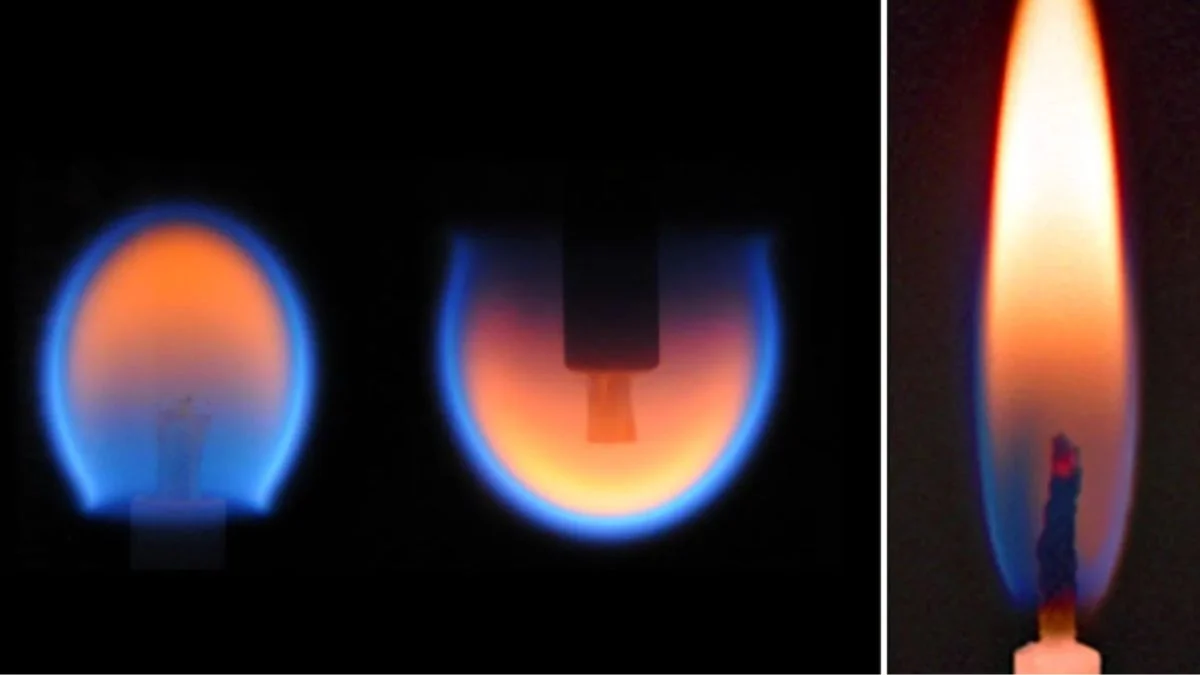
One of the most serious challenges facing upcoming crewed space missions is the risk of fire—a concern that worries mission planners more than almost anything else.
A recent study by researchers from NASA’s Glenn Research Center, Johnson Space Center, and Case Western Reserve University outlines plans to test how materials burn on the Moon’s surface, where fire is expected to behave very differently compared to Earth.
On Earth, gravity causes hot gases from a flame to rise, pulling in cooler, oxygen-rich air at the base. In some situations, especially with materials that are only mildly flammable, this process can lead to “blowoff,” where the flame is extinguished.
On the Moon, however, this airflow still exists but is much weaker. As a result, oxygen continues to feed the flame steadily without creating the fast gas movement needed for blowoff. This means materials that might not burn easily on Earth could potentially sustain flames for much longer in the lunar environment.
For future lunar missions, the possibility of a fire inside a habitat is a serious safety risk. Understanding how fires behave on the Moon is therefore critical, especially as plans move forward for a long-term human presence there.
For years, NASA has relied on a flammability test known as NASA-STD-6001B to evaluate materials for spaceflight. While effective on Earth, this standard doesn’t fully account for the unique conditions found in space.
The test itself is relatively simple: a six-inch flame is applied to the bottom of a vertically positioned material sample. If the flame spreads more than six inches upward or produces burning debris, the material fails. However, the key limitation is that this test is conducted under Earth’s gravity—conditions that differ significantly from those on the Moon.
On Earth, air is constantly in motion, creating convective currents driven by gravity, which establishes clear directions like “up” and “down.” In environments such as the International Space Station, however, those orientations don’t exist.
As a result, flames in microgravity don’t rise upward. Instead, they form slow-growing, spherical shapes that expand outward, relying largely on the station’s ventilation systems to supply oxygen.
Simply shutting down the ventilation system wouldn’t fix the issue. While reduced airflow might slow a fire, it could also leave materials smoldering, ready to reignite once the fans are switched back on.
A more effective approach has been to study how flames behave directly in microgravity. On the International Space Station, researchers have conducted experiments by igniting around 1,500 small flames to better understand how combustion works in space.
NASA understandably wants to avoid fires large enough to damage materials, as that would expose the entire habitable area of a spacecraft to open flames.
Instead, the agency has relied on the Spacecraft Fire Safety (Saffire) experiments. These tests were carried out inside uncrewed Cygnus cargo spacecraft capsules after they separated from the International Space Station and before reentering Earth’s atmosphere, where they ultimately burned up.
During these experiments, researchers ignited large samples of cotton-fiberglass blends, fabric, and acrylic to observe how they burned in microgravity.
The results revealed some unusual behavior, with flames at times spreading against the direction of airflow and burning more intensely on thinner materials.
Findings from the Saffire tests highlighted clear gaps between NASA’s existing flammability standards and how fire वास्तव में behaves in space.
To explore further, researchers turned to another method—drop testing. However, observing flames in a drop tower, which provides about five seconds of weightlessness, or during parabolic flights, offering roughly 25 seconds, isn’t enough to understand the long-term effects of fire in reduced gravity.
This led to the development of the Flammability of Materials on the Moon (FM2) experiment. The Moon’s lower gravity presents an especially valuable environment for studying how flames behave over extended periods.
FM2 is set to launch as part of a Commercial Lunar Payload Services (CLPS) mission to the lunar surface.
Once there, a sealed chamber will ignite four solid fuel samples under sustained lunar gravity—conditions that cannot currently be replicated on Earth. The setup will include cameras, radiometers, and oxygen sensors to track flame behavior and surrounding atmospheric changes in real time.
It will provide the first real link between theoretical predictions of flame behavior in partial gravity and what has already been observed under Earth’s gravity (1G) and in zero-gravity experiments.
Importantly, the experiment will deliver minutes of data—far more than the brief seconds available from drop tests and parabolic flights.
Related: What Would Living on the Moon Really Do to the Human Body?
It remains unclear whether NASA will revise its current flammability standards, as sending a dedicated fire-testing experiment to the Moon is likely to be expensive.
Still, there’s no substitute for real-world data, and FM2 will, for the first time, provide direct insight into how flames behave in the environment of humanity’s next major foothold in the solar system.
Both scientists and science fiction writers will be watching the results closely.
This article was originally published by Universe Today.
About the Author