

The Grand Canyon fascinates and draws the interest of nearly everyone who sees it.
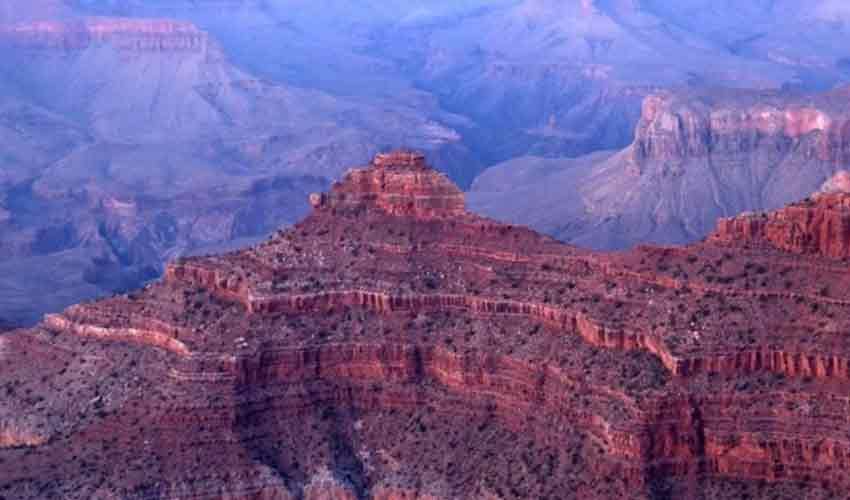
The Grand Canyon is one of North America’s most remarkable natural wonders, located in the southwestern U.S. state of Arizona. Its dramatic cliffs, layered rock formations, and vibrant colors make it a breathtaking geological landscape.
Recent research is shedding new light on how the Colorado River formed and carved its path through the region over millions of years. Scientists analyzed tiny zircon mineral grains found in sandstone deposits—materials carried by the river—as well as volcanic ash layers. These microscopic clues helped reconstruct the river’s ancient routes.
According to the study, around 6.6 million years ago, the Colorado River began flowing into a large basin in northeastern Arizona, creating a vast, shallow lake east of where the Grand Canyon would later develop. Over time, this lake filled and eventually overflowed about 5.6 million years ago, cutting a channel that became the foundation of the Grand Canyon.
The river then continued through a series of downstream basins, eventually reaching the Gulf of California roughly 4.8 million years ago, where it emptied into the sea in what is now northwestern Mexico. The ancient lake—informally named Bidahochi Lake by researchers—once stretched over 90 miles (150 km) and covered areas that are now part of the Navajo Nation, but has since disappeared.
UCLA geologist John He, co-lead author of the study published in Science, explained that zircon grains act like tiny time capsules, preserving evidence of where sediments originated. The dating of volcanic ash layers also helped establish when these river sediments were deposited.
The Colorado River itself begins at La Poudre Pass in Rocky Mountain National Park in Colorado and flows about 1,450 miles (2,330 km). A key scientific question has long been what path the river followed before it carved the Grand Canyon. Researchers now know it existed in western Colorado around 11 million years ago but did not enter the Grand Canyon region until after 5.6 million years ago, leaving a long period of uncertainty about its route.
Other geological processes may also have influenced how the river changed direction over time.
Today, the Grand Canyon stretches about 280 miles (450 km) in length, up to 18 miles (29 km) wide, and more than a mile (1,860 meters) deep. Its exposed rock layers reveal nearly 1.8 billion years of Earth’s history.
Scientists estimate that the Colorado River continues to shape the canyon, eroding rock at an average rate of 100 to 160 meters per million years. This means the canyon is still evolving, slowly deepening over time.
As researchers note, the Grand Canyon continues to inspire awe and curiosity. Even those without a background in geology often ask the same fundamental questions: how did it form, and when? The canyon’s vast exposed rock walls serve as a powerful reminder of deep geological time, revealing the planet’s long and complex history in a single breathtaking view.
About the Author