
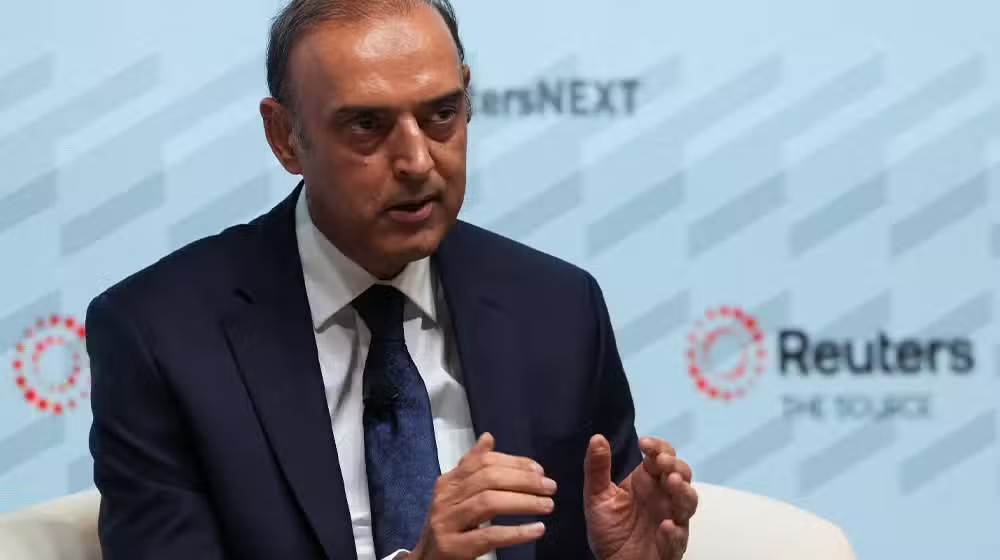
State Bank of Pakistan (SBP) Governor Jameel Ahmad has stated that the country’s foreign exchange reserves are expected to improve to approximately $18 billion by the end of June 2026. He attributed the projected increase to ongoing dollar purchases and the expected realization of official inflows, including new bilateral financing arrangements.
The governor presented these projections during a briefing with senior executives from major global financial and investment institutions, including JP Morgan, Barclays, Citibank, Jefferies, and Franklin Templeton, along with leading credit rating agencies such as Fitch Ratings, Moody’s, and S&P Global.
The session was held on the sidelines of the International Monetary Fund (IMF) and World Bank Spring Meetings, which took place from April 13 to 18, 2026.
The SBP Governor highlighted that Pakistan’s key macroeconomic indicators have improved more quickly than initially expected at the start of the fiscal year, despite heightened global uncertainty caused by the ongoing conflict in the Middle East.
He said average inflation stood at 5.7 percent during the first nine months of the current fiscal year, while the external current account remained in surplus. Foreign exchange reserves held by the SBP rose to $16.4 billion, mainly supported by the central bank’s purchases from the interbank market.
According to him, this improving macroeconomic stability has helped drive a gradual, sustainable, and broad-based economic recovery. Real GDP growth increased to 3.8 percent in the first half of FY26, compared with 1.8 percent in the same period last year.
He further noted that Pakistan’s economic fundamentals are now significantly stronger than during previous global shocks, including the Russia–Ukraine conflict in 2022.
The governor added that considerable progress in stabilizing the economy had already been achieved before the escalation of tensions in the Middle East. A balanced mix of monetary and fiscal policies helped bring inflation back within the target range while also strengthening both fiscal and external buffers.
However, he acknowledged that recent developments in the Middle East—such as rising global energy prices, higher freight costs, and increased insurance premiums—pose fresh challenges. Despite this, he reaffirmed that both the SBP and the government remain committed to maintaining price stability and supporting macroeconomic stability through timely policy measures.
He also stated that monetary policy continues to be cautiously calibrated, with the real policy rate remaining firmly positive. On the fiscal side, the government has maintained primary surpluses while implementing targeted subsidies and austerity measures to manage economic pressures.
Jameel Ahmad further pointed to the staff-level agreement with the IMF under the third review of the Extended Fund Facility and the second review of the Resilience and Sustainability Facility, along with recent credit rating affirmations, describing them as independent validation of Pakistan’s ongoing reform efforts and commitment to stability.
During his visit, the SBP Governor also interacted with members of the Pakistani diaspora and international stakeholders at the Remittances and Roshan Digital Account (RDA) Roadshow. He revealed that inflows through the RDA have exceeded $12.4 billion, spread across more than 917,000 accounts.
He further stated that recent regulatory improvements, including the addition of non-resident entities, are designed to deepen Pakistan’s integration with global financial markets and help attract a broader range of foreign investment.
About the Author