

Scientists have discovered that male octopuses possess a specialized arm equipped with a sensory organ that can detect the female hormone progesterone, allowing them to locate mates even without seeing them.
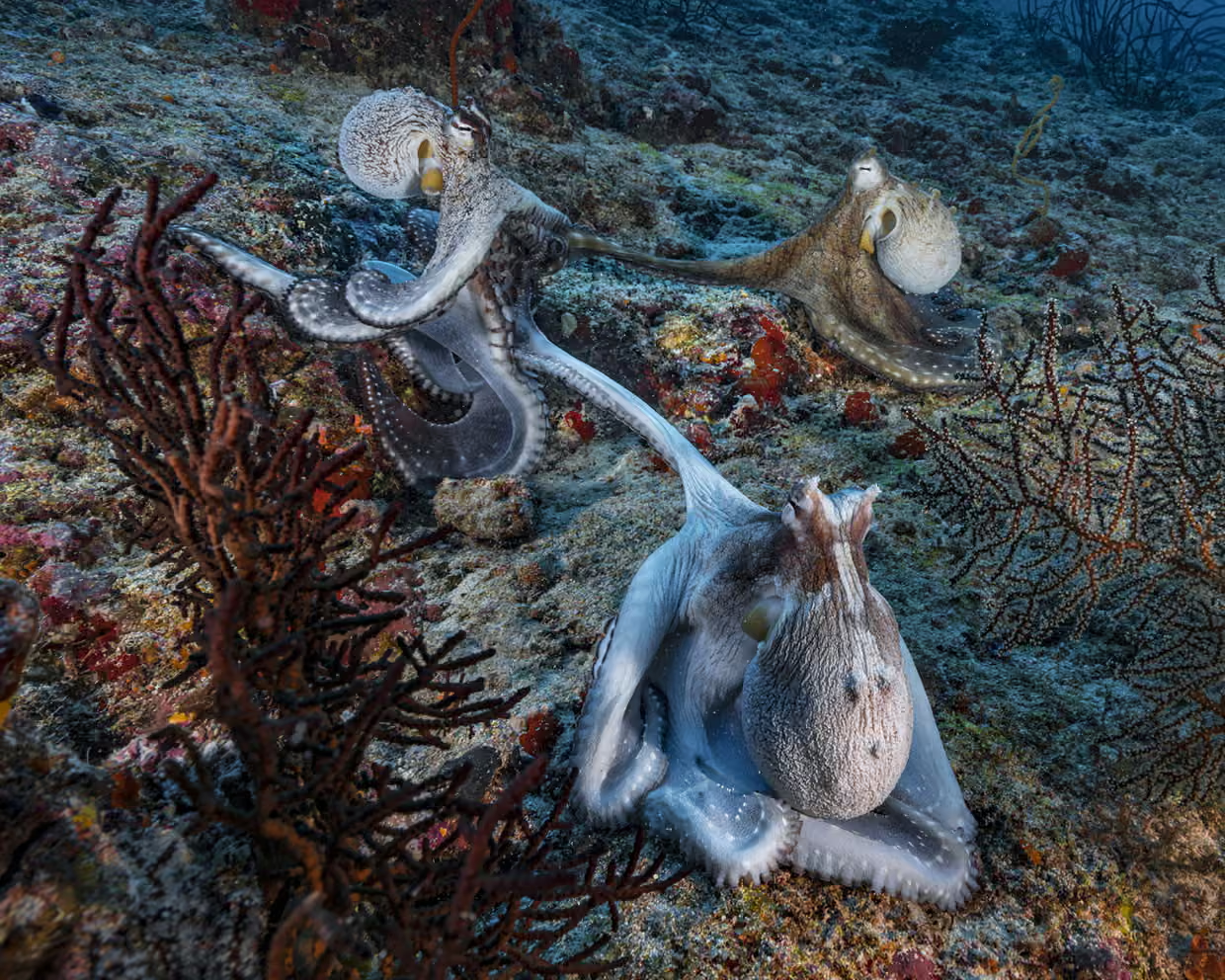
Scientists have revealed new insights into how octopuses mate from a distance.
Male octopuses use a specialized arm, known as the hectocotylus, to deliver sperm directly into the female’s reproductive system. Until now, how this arm located a mate or ensured accurate sperm delivery was unclear.
Researchers have discovered that the hectocotylus acts as a sensory organ, similar to a tongue, capable of detecting the female hormone progesterone. This allows males to find and fertilize a mate even without seeing her.
Prof. Nicholas Bellono, senior author from Harvard University, explained that the mechanism fits the octopus’s solitary lifestyle.
“It makes sense that the arm serves both as sensor and mating organ. In these brief encounters, it must locate the female, find the oviduct, and quickly initiate mating—or move on,” he said.
The findings, published in Science, were led by first author Pablo Villar, who detailed the team’s approach to studying octopus mating behavior.
“This is particularly challenging with octopuses, especially in laboratory conditions, because they are solitary creatures,” said Prof. Bellono. “They rarely interact, and when confined together, they often fight—sometimes fatally.”
To study mating, the team placed a pair of California two-spot octopuses in a tank separated by a black, opaque barrier with holes just large enough for their arms to pass through. The initial plan was to let the octopuses get familiar with each other before removing the barrier.
Unexpectedly, the male inserted its specialized hectocotylus arm through a hole, located the female, inserted the arm into her mantle—the sac housing vital organs—found the egg-transporting tubes, and began mating.
This behavior was consistent across other male-female pairs and even occurred in complete darkness, indicating that mating could happen without visual contact. However, no mating attempts were observed between male-male pairs.
The researchers investigated whether female octopuses released a chemical cue from their reproductive organs. They identified the hormone progesterone in the ovaries and skin of females.
Further tests showed that amputated specialized arms of males responded to progesterone by moving, but did not react to other similar hormones, confirming the arm’s sensory ability to detect the female-specific signal.
The researchers returned to their original setup, separating males and females with a barrier containing holes. Before mating could occur, the female was removed and the holes were fitted with tubes filled with different substances.
The results, said Bellono, were striking: unlike other tubes, males actively explored—and attempted to mate with—the tube containing progesterone, indicating that the hormone alone is sufficient to trigger key mating behaviors.
Further experiments revealed receptors on the tip of the male octopus’s specialized arm that detect progesterone. These receptors appear to have evolved rapidly across cephalopods, suggesting that different species may respond to distinct chemical cues. “This raises the intriguing possibility that these chemical signals encode both sex and species identity,” Bellono explained.
While male specialized arms in other octopus species and cephalopods also responded to progesterone, their sensitivity to other hormones varied. Bellono noted that the findings provide insight into how sensory systems evolve to maintain reproductive barriers—or, in some cases, allow crossbreeding and the emergence of new species.
He emphasized the importance of careful observation in science: “We didn’t plan to study this arm as a sensor—it was revealed to us simply by watching the animals.”
About the Author