
When NASA’s Orion capsule splashed down in the Pacific Ocean April 10, completing a successful Artemis II mission milestone, a critical piece of the spacecraft’s safe return traced back to research at Rice University.
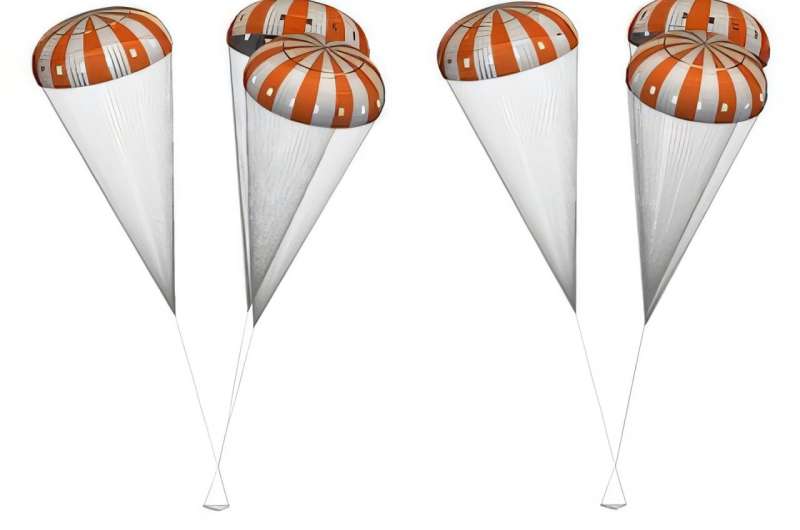
The capsule’s three-parachute system—designed to slow Orion’s descent and ensure a safe landing—was developed using advanced computational fluid-structure interaction (FSI) analysis by mechanical engineer Tayfun E. Tezduyar and his longtime collaborator Kenji Takizawa, in partnership with NASA’s Johnson Space Center. Their team was the only one to provide this type of computational analysis for the parachute system, completing the work in 2013—years before Orion’s return to Earth.
This modeling played a crucial role in addressing one of the toughest challenges in spacecraft parachute design: ensuring the parachute is large enough to safely slow the spacecraft while remaining stable during descent, without speed fluctuations caused by shape instability.
“For a given spacecraft weight, the parachute must produce sufficient aerodynamic drag to ensure a safe landing speed,” Tezduyar explained. “Equally important, however, is maintaining a stable shape. If the drag varies, the descent speed will also fluctuate, which can jeopardize a safe landing.”
The challenge lies in the close relationship between aerodynamics and structure. While the parachute’s shape determines its aerodynamic performance, that shape itself is influenced by the forces acting on the fabric. This two-way interaction—known as FSI—means accurate aerodynamic analysis must also account for structural behavior. The difficulty increases further with larger parachutes, where these interactions become even more complex.
“You cannot separate aerodynamics from structural dynamics,” Tezduyar said. “They constantly influence one another—especially in large spacecraft parachutes—so the analysis must capture this interaction through a tightly coupled approach.”
He explained that early designs, which were based on scaled-up Apollo-era parachutes, exposed serious concerns. NASA’s drop tests revealed significant fluctuations in parachute diameter—an indication of shape instability that could result in unsafe landings. Using high-precision FSI simulations at Rice, Tezduyar and Takizawa’s team confirmed the problem and helped steer the design toward a more stable solution.
The final parachute system, refined through a combination of NASA’s drop tests and Rice’s computational analysis, successfully removed these fluctuations, resulting in a stable descent profile suitable for human spaceflight.
The partnership also helped cut down development costs and time. Physical drop tests were expensive and heavily dependent on weather, so the Rice team’s simulations enabled NASA engineers to assess designs virtually before moving to real-world testing.
“We conducted numerous simulations to evaluate different canopy shapes and suspension-line configurations,” Tezduyar said. “Although each simulation required substantial computational power and time, it helped us identify the most promising designs and significantly speed up the overall development process.
The project also advanced the frontiers of computational engineering. Simulating Orion’s parachutes required solving highly complex equations that capture both airflow and fabric deformation at the same time, while also accounting for intricate design features such as ringsail canopies—with hundreds of gaps and slits—and the aerodynamic interactions between multiple parachutes operating together in a cluster.
Tezduyar stressed that the achievement was the result of a dedicated team effort.
“We worked extremely hard at Rice to complete our part of the project on time,” he said. “Nearly my entire research group was focused on this work because I saw it as a national priority. Kenji and I were personally involved in every simulation. Some of the most talented graduate students and research associates I’ve worked with contributed to the project, developing a series of unique, first-of-their-kind parachute simulations.”
Many of these computational efforts are detailed in a recent book co-authored by Tezduyar and Takizawa.
More than a decade later, their work quietly played a vital role in one of NASA’s most significant successes.
About the Author